
St. Augustine’s Confessions presents us with a man in crisis seeking The Good Life. Arguably the first autobiography in Western culture, Confessions—written between AD 397 and 400—chronicles Augustine’s spiritual and existential journey from being a horny young man wracked with guilt to a horny middle-aged man wracked with guilt but saved by God’s grace. The book begins with one of Augustine’s most recognized quotes: “You have made us for yourself, O Lord, and our hearts are restless until they rest in you.” A restless man, Augustine struggled with such strong desires and affections—the sexual, the sensual, the spectacles of his culture—that his recorded prayers often read like outbursts of passionate yearning; they are more like groans and howls than they are pious theological treatises.
Hundreds of Beavers begins with an on-screen title featuring one of Augustine’s prayers: “Lord, grant me chastity…but not yet.” It is the plea of a pilgrim who feels lost, a man who has striven to overcome his vices by his own effort and cannot. It is also the doorway through which we enter into the gut-busting hilarious cinematic world that writer-director Mike Cheslik and writer-actor Ryland Brickson Cole Tews have created. Hundreds of Beavers is not only an indie DIY pastiche of silent slapstick, looney Chuck Jones-esque animation, and Let’s Play video game walkthroughs—it’s also a subversive, quasi-religious parable about the transformative power of pilgrimage. In the spiritual tradition of Augustine and Aristotle, Hundreds of Beavers is about the pursuit of The Good Life (eudaimonia) and the importance of gaining practical wisdom (phronesis) through virtuous efforts, overcoming vices, and trying to catch and kill people dressed in animal mascot costumes. Indeed, Hundreds of Beavers is the perfect blend of sagacity and stupidity; its wisdom is found in its foolishness.
Following an opening musical number where we are introduced to Jean Kayak (Tews), an alcoholic applejack salesman in the 19th-century Wisconsin wilderness, a second quote appears on screen as a kind of epigraph:
It is always hard to see the
purpose in wilderness wanderings
until after they are over.
The quote is (wrongly1) attributed to John Bunyan, and is ostensibly from his classic religious allegorical tale, The Pilgrim’s Progress.2 Bunyan’s allegory is pretty obvious and heavy-handed: a man named “Christian” journeys from his hometown of the City of Destruction towards the Celestial City. He encounters places like “Slough of Despond,” “Hill Difficulty,” and “Vanity Fair,” all of which present him with obstacles and trials. Christian begins his travels with great loneliness and carrying a heavy burden (i.e., Sin), but while walking along the wall of Salvation, Christian sees Christ’s cross and empty tomb, causing his burden to fall from him. His loneliness is also overcome by the various virtuous characters he encounters, such as Evangelist, Charity, Faithful, and Hopeful. Ultimately, with the help of Faithful and Hopeful, Christian makes it to the gates of the Celestial City.3
By beginning their bonkers movie with the words of a Christian theologian and a Puritan preacher, Cheslik and Tews provide the on-screen ridiculousness with gravitas, ironic self-seriousness, and a sense of being rooted in tradition. The film’s focus on a singular character undergoing a spiritual journey wherein he overcomes obstacles, encounters both companions and antagonists, and ultimately finds redemption parallels The Pilgrim’s Progress, as does its exaggerated and pronounced style. The Augustine quote also imparts a spiritual foundation for the film: like Augustine, Kayak is a restless man of great passion who must reckon with his personal limitations as he searches for The Good Life. Consider the lyrics to the chorus of the musical opening number,4 which are barely discernible when watching the film:
Jean Kayak! Raise up yeer applejack
The legend is one-third half-true!
The color is gold
and we’re all feeling bold
We’ll be getting to
that applejack brew…
Save me.
Save me. Accompanying this plea for salvation is the montage of Jean Kayak getting absolutely plastered on his applejack brandy. When a beaver eats one of the support beams of a giant keg of applejack he’s standing on, the frantic Kayak finds himself rolling downhill at breakneck speed. The keg crashes into his cabin’s fireplace and explodes, igniting a massive fire and destroying Kayak’s apple orchard. He has hit rock bottom. It would take a miracle for him to recover.
So, how does one reach The Good Life? In Aristotle’s Nicomachean Ethics, the Greek term eudaimonia is typically translated as ‘happiness,’ but is better understood as ‘flourishing,’ ‘joy,’ or ‘the good life.’ Aristotle presents this virtuous life as both the means and goal of happiness. One of the ways to attain this is phronesis, translated as ‘practical wisdom.’ A person with phronesis has the good judgment and everyday street smarts earned only through practice and experience. It’s not merely intellectual head knowledge—it’s a kind of earned wisdom where you can show the receipts and the scars.
Jean Kayak wants The Good Life. But first, he has to survive. Awakening in the wintry wilderness of Wisconsin, his house and orchard only charred remains, Kayak’s first instinct is to secure Maslow’s basics: shelter from the elements, water, and food. In one of the first of many sight gags, Kayak builds a fire to keep warm. The ever-changing wind blows it out again and again, prompting Kayak to fling his body onto the open flames. He wakes up on fire. He puts out the fire with snow. Lesson learned. Over time and through repeated failures, Kayak gains the knowledge to not only make a fire, but to keep it lit and protected from the elements.
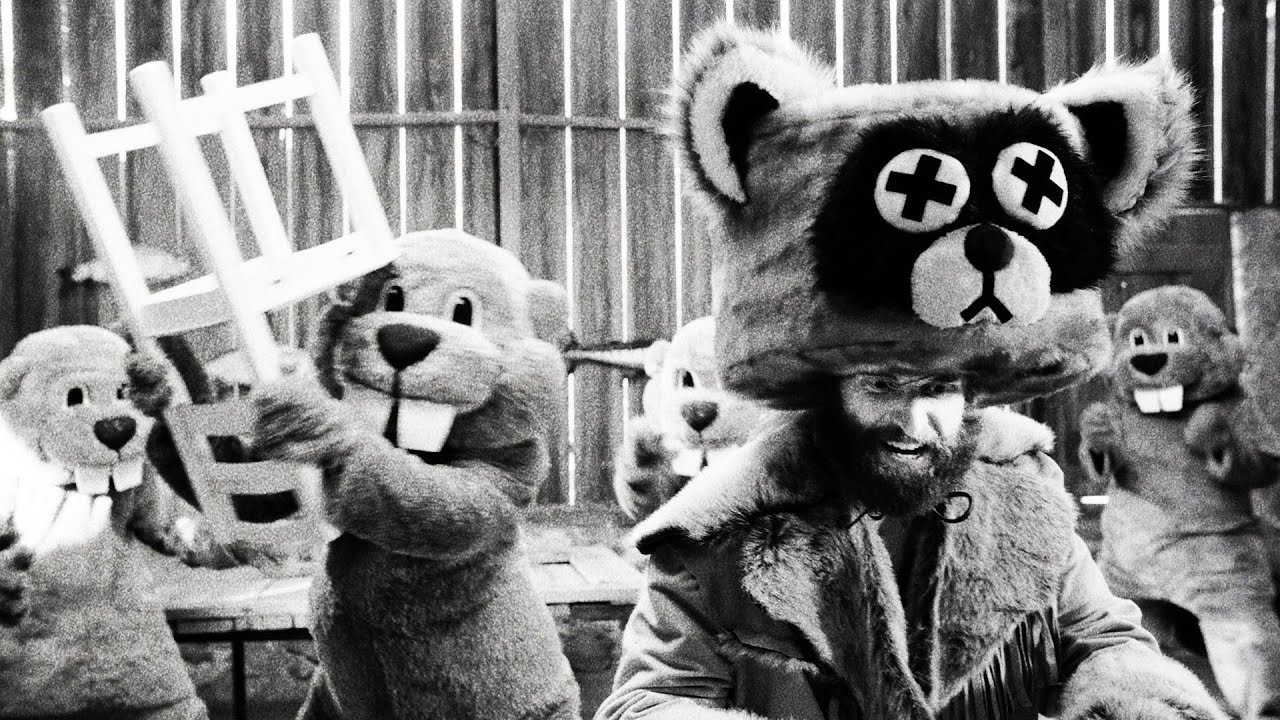
Wandering the snowy landscape in his search for food, he tries to catch the local wildlife. The first animal he notices are the rabbits. But they’re fast and skittish. Kayak’s efforts grow in their complexity until he’s created Rube Goldberg-level contraptions to catch his prey. It’s a live-action Wile E. Coyote and the Road Runner, with Kayak learning from his mistakes through trial and error. When he encounters a group of beavers, Tews literally throws himself into his performance, hurling his body into snow drifts with wild-eyed abandon and no discernible hesitation. In one scene, he flings himself down a hill on a sled, crashing into the log-carrying beavers below, briefly knocking them off their feet before they recover and kick him like they’re in a street gang. It’s slapstick comedy, all Buster Keaton or Abbott and Costello, a complete willingness to sacrifice one’s own body for the bit. Tews fights real beavers (or at least people dressed up in beaver costumes) in real midwestern snow. He even got frostbite from filming in the negative-degree Wisconsin weather for the 12-week shoot spread over two winter seasons (2019 and 2020).
After Kayak finally secures food by catching fish from a frozen lake using his own bleeding fingers as bait, he sees a Santa Claus-like figure in the distance. This is The Master Fur Trapper (Wes Tank), one of the few human characters Kayak encounters in this pilgrim’s progress. Kayak follows The Master Fur Trapper to the trading post run by The Merchant (Doug Mancheski), a cantankerous and conservative man with a beautiful daughter, The Furrier (Olivia Graves), and a habit of chewing tobacco. A running gag in Hundreds of Beavers is The Merchant’s failed attempts to spit his tobacco into a spittoon. This gag, along with dozens of others throughout the film, is comedically effective due to Cheslik’s keen directorial, animating, and editing skills. It’s as if the ‘comedy’ knob was turned up to eleven, then never adjusted. The timing and visuals are so precise as to elicit a veritable deluge of jokes, keeping the audience at near-constant laughter—you’ve barely managed to catch your breath before there’s another hysterical on-screen moment, then another and another, without any of it ever becoming tired or overdone.
There is almost no actual dialogue; human communication is done in grunts and exclamations, such as “aha,” “hmm,” and “uh oh.” This makes Hundreds of Beavers universally translatable. The film distills cinema to its basic foundations: moving images of people falling over in the snow wearing mascot costumes. The grainy black-and-white visual aesthetic also gives Hundreds of Beavers a timeless quality, even as its obviously artificial special effects perfectly blend with its real-world wilderness locations and actors. In an interview, Cheslik puts it this way: “The idea is you pick a lo-fi style so that the location shooting and the effects all just sort of bleed together. You make the real stuff look a little fake, and you make the fake stuff look as real as you can. I find that when I do my best, people say, ‘I love how you made it bad on purpose.’” The paradox of Hundreds of Beavers is that it’s unabashedly sincere and real even as it’s plainly artificial (i.e., people wearing beaver costumes standing in front of a green sheet). This bleeding together of the good and the bad, the real and the fake, echoes Augustine’s emotionally demonstrative Confessions, as well as Bunyan’s allegorical Pilgrim’s Progress: all of these works, the film and the texts, resonate with the human condition on a fundamental level precisely due to their undisguised emotionality, their wearing of their hearts on their sleeves, their unabashed obviousness. There’s no hypocrisy, no hidden motives, no barriers; everything is laid out in front of us, naked and vulnerable and clear. There is thus a universality and timelessness to these works as they speak afresh to each passing generation through their simplicity and forthrightness. We read of Augustine’s profound restlessness, and we can relate. We can’t visit Hill Difficulty in real life, but we know exactly what Bunyan was describing.
Indeed, Hundreds of Beavers is hilarious to both kids and adults of all creeds and cultures; it transcends political divides and miraculously unites us in our laughing at a guy pulling hand-crocheted fake fish out of the butt of his long johns while flopping around in the snow. But it also connects with us on a more primal level: it’s about another human being striving to find The Good Life, something we all desire yet often struggle to express, lest we sound trite, selfish, or insecure. Confessions, Pilgrim’s Progress, and Hundreds of Beavers have each overcome this struggle—they are unapologetically expressive of these deeper human longings, sometimes in embarrassingly over-the-top ways.
Back to the pilgrim’s progress: The Merchant wants The Master Fur Trapper to marry his daughter. The Furrier wants to have autonomy and agency in her romantic relationships. The Master Fur Trapper wants to keep on trapping. The Master Fur Trapper’s dogs want to catch squirrels. But Jean Kayak wants more than all this: he still craves The Good Life. Infatuated with The Furrier and in admiration of The Master Fur Trapper, he trades his fish for money, then turns in the money for a tiny knife, which he then uses to slice up his shirt in order to make a rope. After falling into numerous holes in the snow (another great running gag), he realizes that the rabbits use a tunnel system, so he sets up a trap with the rope. The rabbits are lured in by Kayak’s hand-carved carrots, but the waiting raccoons keep eating them. So, Kayak cuts up his pants to hoist the rabbits in the air and out of the raccoons’ reach. The now-nude Kayak manages to accidentally catch a raccoon in his trap. He’ll take what he can get; he subdues and kills it in a brutal knife fight. Bloodied and naked, he carries the raccoon carcass in the deep snow, with The Merchant as his destination. After running into an indigenous man, The Indian Fur Trapper (Luis Rico), who trades him snowshoes for the knife, Kayak arrives back at The Merchant’s outpost where The Furrier skins the raccoon and makes Kayak clothes and a gigantic coonskin cap. He stands atop a barrel, proud and fully clothed in raccoon skins he caught for himself. He wolf-whistles in triumph, provoking a woodpecker to fly into his face and peck him mercilessly (yet another great running gag). Now, 33 minutes into the 108-minute film, Hundreds of Beavers finally shows us the credits, though not the actual film title—this will not come until the 1 hour 15 minute mark, challenging films like Drive My Car and RRR for The Longest Delay Until Showing Us The Movie Title. Why this postponement? Perhaps it’s a reward for those film-watching pilgrims who have made it thus far in the journey with Kayak. Perhaps it’s just plain silliness. A reprise of the opening song during these credits provides us a clue—this is a turning point in this pilgrim’s progress: “A lesser man’s put down his applejack / The path it is frozen but clear / he’s put on his head, a lass for his bed / he may live to see twenty years / So he’ll dress himself up like a trapper / assemble the tools of the trade / The legends will surely poke fun at him / as God help him, his fortunes made.”
As the song says, the path (and the Aristotelian logic) is clear: Kayak uses practical wisdom from his life experiences to successfully catch a wild animal and gain the resources to continue on his quest for The Good Life. He was drunk; now he’s sober. He was hungry; now he’s fed. He was naked; now he’s clothed. This takes courage, generosity, and ambition, all virtues found in the Nicomachean Ethics. At this point, the movie shifts to the second act, adopting the logic of a video game walkthrough. Follow The Master Fur Trapper. Learn the correct bait for each animal: carrots for rabbits, frogs for skunks, poop covered in castor oil and/or crucifixes for beavers. Watch out for raccoons and wolves. Catch the animals, get the furs, then turn them in for money to buy better gear for making better traps. Learn new skills, level up, and keep going.
When a pack of wolves kills The Master Fur Trapper and steals his collected beaver furs, Kayak acquires the Trapper’s confusing trapline guide, which he promptly erases in order to make his own map. In this section, Hundreds of Beavers uses the trapline map to move us from scene to scene, its animation style looking and sounding like the maps in Super Mario Bros. 3 for the original Nintendo NES. It’s akin to watching a Minecraft or Mario walkthrough, if funnier and more cinematic. Even the sound design, from the musical score to the sound effects, alludes to classic video games; for instance, when an animal is trapped or killed, an icon appears on the screen as we hear a satisfying 8-bit blip. The map also is an echo of similar maps in The Pilgrim’s Progress, with Kayak as the Christian analogue. As he moves from location to location on the trapline—the wolves’ cave, the indigenous man’s home, a frozen pond, a wooded area—he draws it in with his goose-shit writing implement. His campfire functions like a video game loading screen, a brief pause in Kayak’s pilgrimage before he (and we) continue on the journey.
Through his endeavors, he earns enough to procure an axe, two traps, a club, and a gun from The Merchant. By now what he really wants is to marry The Furrier—The Good Life is only truly good when it is shared. Only The Merchant stands in Kayak’s way; he still believes the young man to be the irresponsible drunk who burned down his own orchard while partying. So, Kayak must prove himself—he must demonstrate that he is truly virtuous, what Aristotle would call a “great souled” person. The cost for her hand in marriage? Well, you can already guess. Cue the title card.
At the very center of Kayak’s map is a Christian cross, signifying the location where Kayak buried The Master Fur Trapper and set up a crucifix he carved with his own teeth as a grave marker. It seems significant that the cross is the site around which everything else in Kayak’s journey revolves. Apart from a few moments of genuflection. Kayak’s religious impulses are not typically overt. But the centrality of the cross for his pilgrimage towards The Good Life suggests that there is an underlying spiritual resonance on display. The only other characters to carry the Christian cross are the titular beavers, who also appear to be Catholic—at one point, they conduct a funeral service for their deceased brethren, with a fully-robed beaver priest carrying a thurible. The beavers represent all that is wrong with conservative religious institutions. They are a destructive homogeneous mass committed to building an empire by exploiting the natural world and violently policing others’ behavior, all while baptizing their ventures with supposed divine approval. In contrast, Kayak appears to be untethered to traditional institutional religion, yet nevertheless has a deep spiritual restlessness paralleling Augustine, one which continues to motivate him in his quest for The Good Life. The cross as the fixed point around which his pilgrimage revolves suggests that Kayak’s “spiritual but not religious” meanderings have an anchor and a purpose.
Kayak continues to grow his trapping enterprise, but his activities have not gone unnoticed by the beavers. While Kayak builds ever more elaborate traps for catching and killing the local fauna, a pair of detective beavers dressed like Sherlock Holmes and Watson follow and observe the trapper. To their eyes, he is a mass murderer, evil incarnate. When the pair of detectives report back to the rest of the beavers, they send a large squadron after Kayak, who lures them all into the wolves’ cave and seals the entrance with icicles after launching a skunk into their midst. Following the stink-filled slaughter, Kayak brings the giant mass of mascot bodies back to The Merchant’s cabin, only to discover he’s been tricked by a fake cutout made by the beaver detectives. Kayak’s pursuits have been all for naught.
This brings us to the third act of Hundreds of Beavers, a genre-transcending action-packed thrill ride. The beavers take the bodies back to their dam, a massive structure evocative of Bruegel’s The Tower of Babel. Kayak employs his practical wisdom to sneak into the dam, only to face his greatest challenge yet: the beavers have his other keg of applejack. It’s the ultimate test of his physical and moral fortitude as he instantly regresses into his pre-phronesis dudebro self. Tews’ performance is a striking blend of comedy and pathos as his rational mind and appetitive body vie for control. His eyes wild, he communicates this internal struggle with addiction through a series of exaggerated movements and impassioned grunts, moving first towards, then away from, then back towards the keg. As he finally overcomes this temptation and runs after the beaver pelts, you feel compelled to cheer—virtue has won the day.
When Kayak is subsequently caught by the beavers and put on trial for his life, Hundreds of Beavers becomes a courtroom drama complete with a reference to Émile Zola (“J’accuse…!”). When he fights his way out of mortal peril by once again employing his phronesis to escape his restraints, Hundreds of Beavers morphs into John Wick, filled with extreme mascot-eviscerating violence. What becomes clear in this sequence is that the beavers are truly villainous: they are wantonly exploiting the natural environment by clear-cutting forests for their consumer capitalistic purposes of building massive ugly towers and meaningless rockets to space as self-congratulatory works of idolatry and greed. They also plan to skin Jean Kayak alive and turn him into a coat, which is what they did with The Master Fur Trapper’s body. It’d be horrifying if it wasn’t so goofy.
This culminates with Kayak accidentally sabotaging the beavers’ grand project, leading to a massive manic chase scene, a cinematic nod to Buster Keaton’s Seven Chances as hundreds of beavers pursue Kayak across the snowy landscape. Beavers are kicked, punched, shot, decapitated, lit aflame, and tossed into chasms. They eventually assemble into a beaver kaiju, the final boss in this video game odyssey. In the final minutes, Kayak finds himself running atop a mammoth rolling snowball filled with his trapped beaver pelts while the beavers’ rocket ship explodes behind him in a fiery mushroom cloud. In this climactic moment, the camera zooms in on Kayak’s face as it cuts to the earlier opening scene of him riding the applejack keg downhill and exploding. Like Augustine, he calls to mind memories of mistakes made by his past immature self, learns from them, and overcomes them through practical wisdom: he stops the snowball just short of The Merchant and The Furrier’s cabin, hops down to embrace his bride-to-be, and receives a massive Bugs Bunny smooch on the mouth from his soon-to-be father-in-law. Jean Kayak has reached the satisfactory telos of his pilgrimage; he has achieved The Good Life.
***
In the book Religion and Film: Cinema and the Re-creation of the World, author S. Brent Plate draws from cultural anthropologists Victor and Edith Turner’s broad definition of pilgrimage in claiming that certain film-viewing could be considered a type of religious pilgrimage: (1) a journey of leaving “home” or the familiar into (2) a liminal or threshold space as the pilgrim travels to a sacred place, and (3) a return, having been spiritually affected or transformed.
The first time I watched Hundreds of Beavers, I was alone on my couch. I laughed. The second time, I invited my family to watch it with me. We laughed and laughed. The third time, my kids and I couldn’t decide on a Christmas movie to watch until one of them mentioned the Santa Claus character and winter setting. The consensus was immediate: Hundreds of Beavers is a Christmas movie. We laughed and laughed and laughed.
Which leads me to December 5, 2024, the Eve of the Feast of St. Nicholas. On this winter night, as a true Beaver Believer, I embarked on my own religious pilgrimage, leaving home into a liminal sacred space where I hoped I would be transformed. I left my small town in Oregon wine country, braved two hours of Portland rush hour traffic, and crossed state lines in order to see Hundreds of Beavers in a movie theater with an audience. My destination: the Kiggins Theater in Vancouver, WA. I laughed again, along with thousands of other beaver-loving cinephiles across the nation in their own local indie theaters hosting Hundreds of Beavers on this special night.
What is The Good Life? It is sitting on the couch with your children to watch a movie, laughing with them until you’re all exhausted, then repeating the movie’s lines to one another afterward over dessert, giggling all over again. It is seeing your romantic partner squeal in shock and delight at the scene of Jean Kayak encountering two orphaned baby bunnies in the snow and what he chooses to do with them. It is sitting in a movie theater with a group of strangers who have all traveled there for one purpose: the mysterious spiritual camaraderie that comes from witnessing a Truly Good Movie.
- Though this quote repeatedly appears in print and on Goodreads as being from Pilgrim’s Progress, John Bunyan never wrote these words. They come from an endnote written by C.J. Lovik, an editor and commentator for the Crossway Books publication of Pilgrim’s Progress. See John Bunyan, The Pilgrim’s Progress: From This World to That Which Is to Come, edited by C.J. Lovik (Wheaton: Crossway Books, 2019), p. 231. It’s still a nice quote; it’s just not from John Bunyan.
- Full title: The Pilgrim’s Progress from This World to That Which is To Come: Delivered under the Similitude of a Dream Wherein is Discovered, the manner of his setting out, His Dangerous Journey; And safe Arrival at the Desired Country.
- This is just “The First Part” of The Pilgrim’s Progress. The Second Part is about the journey of Christiana, Christian’s very originally-named wife.
- The opening song “Jean Kayak and His Acme Applejack” is written and sung by Wayne Frank Tews and The Seafield Monster Sextet. Wayne Tews is Ryland Tews’ father.