
“Dis-cursus—originally the action of running here and there, comings and goings, measures taken, ‘plots and plans’: the lover, in fact, cannot keep his mind from racing, taking new measures and plotting against himself. His discourse exists only in outbursts of language, which occur at the whim of trivial, of aleatory circumstances.”
—Roland Barthes, A Lover’s Discourse
Phone numbers scrawled on paper strips flutter coquettishly in the wind. A woman rests her forehead on the edge of the bulletin board. Nervous, she pulls away and peers around the wall of restless personal ads to sneak a peek at a man reading the newspaper on a nearby bench. Could it be him, the man she has been waiting to sweep her off her feet? It must be. She paces back and forth and spins around, spins back, and nearly runs over to him.
“You’re not waiting for me, are you?” she says, clutching her purse close to her chest.
He meets her gaze briefly, then returns his attention to his newspaper. “Maybe.”
“It’s very nice to meet you,” Liuba interrupts the man who is reading.
He invites her to sit down and can’t take his eyes off of her, so that when he utters the vague words “Beautiful weather,” it sounds like he is reciting poetry about her. Still, it’s all very strange to Liuba—why publish the ad, set a time and place to meet, and then leave it entirely up to her to find him and start the conversation? But then, he is so handsome, and clearly such an intellectual, and he says he genuinely finds her stunning. She jumps at him and kisses him, and then they walk together for some time, enjoying each other’s company. He tells her about his life and how he’s recently come into some financial trouble. Liuba is eager to help her newly beloved.
Seduction can go by many names: deception, trick, con, scam. What’s the matter with saying whatever you need in order to get what you want? The game of seduction is always a trap: disdainful charm cajoles distrustful admiration into a momentary feeling of love. The seducer must strike a fine balance between predation and charm in order to capture their prey. Seduction without attraction is only a trap; seduction without predation is a fleeting look, a passing thought without any of the reward on either side. So, we let ourselves be fooled. But that’s also the magic of seduction: it’s the one scam we enjoy happening to us. The power of the affair relies on the intoxicating mixture of danger and desire. How do you know you’re being scammed? Once you’ve already fallen for it.
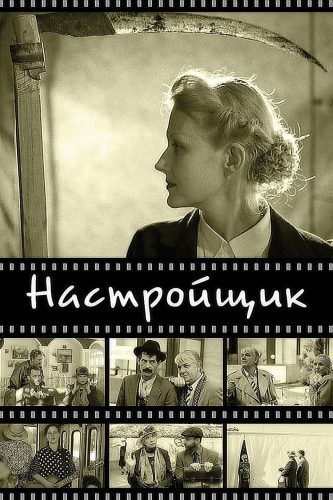
Kira Muratova’s film The Tuner (2004) cuts between seemingly unrelated moments, abandoning comfortable transitions while remaining committed to a chronological progression of distorted time. There’s Liuba (Nina Ruslanova), a former nurse and hopeless romantic. Anna Sergeevna (Alla Demidova) is her wealthy friend. Andrei (Georgy Deliev) is a skilled con artist and musician, and Lina (Renata Litvinova) is his eccentric lover and equally talented swindler. Andrei poses as a piano tuner to gain Anna Sergeevna’s trust and access to her home. On first impression, Lina appears vapid and capricious—but she helps Andrei pull off the scam in her own vaguely threatening and mysterious way. By the end, the two lovers manage to pull off an elaborate forgery scheme, cheat the two elderly women out of their personal funds, and escape detection. Through the perspective of Andrei and Lina, we see the scam as a kind of amateur art, a playful and creative form of manipulation. Filmed in black and white, their predatory nature appears soft and romantic. The edges of Muratova’s film become a bit blurry—from its depiction of social norms and human impulses, to the form of the melodrama itself.
It’s no coincidence that there’s a scam at the center of a film made in the years directly following the dissolution of the Soviet Union. While The Tuner doesn’t seem to take place in any specific city, we get the clear sense of a world situated in the socialist afterlife. Here, the decaying vestiges of Soviet attitudes mingle with incipient desire for capital accumulation. Never is this most clearly expressed than through the steady construction of Andrei and Lina’s seduction. Liuba and Anna Sergeevna are self-assured members of the intelligentsia who benefited under Soviet power. Muratova juxtaposes them with the grifters Andrei and Lina, who turn against deluded expectations of polite society, knowing that no such thing can exist in a place where social codes have always been used to control people’s behavior and desires. Along with this, the Ukrainian auteur Muratova favored formal experimentation, audacious and eclectic visuals, and disrupted narratives, for which she was heavily censored in the Soviet Union since her films did not comply with the official cultural guidelines of socialist realism. In The Tuner, Muratova suggests scamming as a method of survival under the perverse post-socialist economic and social regime.
The first time I watched The Tuner, I really thought that I was better than Liuba and her rich friend Anna Sergeevna. I felt like I was in on something. I knew what Andrei and Lina were doing to Liuba and Anna Sergeevna, so I could shake my head at them, I could laugh at their surprise. It wasn’t until later that I realized I had been duped, too.
Andrei is not Liuba’s lover—the man she meets at the beginning of the film is just a random person, one of many who capitalize on her desires in order to extract money and then disappear without a trace. Later, Andrei will come into her life—and after that she will meet the man who actually placed the personal ad, marry him, and then he will run off with her wallet. Liuba should know better than to trust any of these men, but she can’t resist the feeling of wanting to be wanted. Before Liuba can realize she’s let herself get seduced and fooled by a series of handsome and cruel strangers, she and Anna Sergeevna meet Andrei.
When we first see Andrei, he’s making someone laugh so hard that they’re almost falling out of their chair, and generously counting out a fistful of cash to give to him. Andrei leaves the room quickly with many promises to return (he won’t) escaping his lips. On his way out of the building, he pauses to give unsolicited knitting advice to a young woman working on a sweater in the lobby. He even takes the needles and yarn in his own hands to show her how to properly complete the stitches. He leaves us with the feeling of having run into an old friend, one of those people with the rare talent of being good at everything.
Another one of Andrei’s talents is knowing when to stop, listen, and wait for the right opportunity to fall into his lap. That’s how he overhears Anna Sergeevna recite her phone number to an acquaintance and tell her how desperate she is to find a piano tuner. Of course, Andrei’s not a down-on-his-luck musician or a piano tuner. Rather, judging by the way he takes swigs from the bottles of liquor on the grocery shelves and puts them back without being noticed, and by his decision to squat in the attic of an apartment building rather than paying rent, he’s an adept scammer who’s had years of practice in staking out—tuning—his victims.
Around the time I was introduced to The Tuner I was also reading Sianne Ngai’s Theory of the Gimmick: Aesthetic Judgment and Capitalist Form. There’s nothing gimmicky about this film—or about anything Kira Muratova has made—but there is something in Ngai’s words that speaks to The Tuner: “Calling something a gimmick is a distancing judgment, a way to apotropaically ward off the trick’s attractions by proclaiming ourselves unconvinced by them.” We feel distrustful of gimmicks, she explains, because they seem to both intensify work and eliminate it over time. Gimmicks also accentuate capitalism’s promises about saving time and reducing labor while extracting surplus value. Ngai continues, “At the same time the gimmick enables us to indirectly acknowledge this power to enchant, as one to which others, if not ourselves, are susceptible.” To admit that something feels like a gimmick means owning up to its mesmerizing power, if only to put distance between yourself and its tricks.
So, what’s more gimmicky than a scam? The treacherous condition of capitalism offers the scam as a way out, a cheat code for saving time and labor. On the flip side, the only way to get money back, to put distance between yourself and the scam, is to admit to being charmed and fooled. It’s why Liuba continues to search for a husband even after falling for multiple men who are only out for her money. For her, the outcome is unimportant and unrelated as long as she is able to enjoy a situation where she is the object of a seduction again. Name your predator, name yourself as prey, and admit that you liked it.
As Andrei tries to keep the attention on his sleight of hand trick, Lina refuses to be relegated to the position of pawn. When Lina eventually shows up at Anna Sergeevna’s house to take her part in the scam, the threat of potentially murderous intent hangs a menacing shadow over Andrei’s delivery of the money. Lina knocks at the gilded apartment’s door dressed in a tailored suit, smiling broadly, and brandishing an enormous scythe. She introduces herself as a census worker and fabricates a story about how a fire at the office burned up all of their documentation and now requires them to re-collect Anna Sergeevna’s citizenship and property information. Remembering the scythe, Lina asks if it belongs to Anna Sergeevna, who replies that it’s her neighbor’s and nervously watches Lina set it aside. Leading Lina into the living room, Anna Sergeevna asks her, “Can’t you tell me, why did I feel so afraid when I saw you?” She doesn’t quite understand her feelings, but her gut tells her that something is wrong. Lina is the ultimate seductress, carrying the symbol of the Grim Reaper with a huge smile on her face—she’d give anyone that frantic feeling of butterflies in their stomach. More than a secret joke between Lina and the viewers, the scythe also reflects the symbolic sickle of socialism. Whereas agricultural workers use it as a tool to reap their crops, in this post-socialist world, Andrei and Lina transform it into a symbol of their twisted efforts to glean Anna Segeevna’s funds. Their seduction reduces former socialist allegiances between workers to a visual gag, easily set aside while the scheme moves forward.
At the end, the scam’s moving parts come together. Andrei has earned the two women’s trust by tracking down the man from the personal ad that Liuba marries after her first strange encounter and recovering her wallet. At the same time, he falsifies a copy of a page from the phonebook, replacing the bank’s number with Lina’s. He tells the two women that their lottery numbers were picked, and Lina, impersonating a bank teller, answers the phone when Anna Serveevna calls to confirm her number. The two women give Andrei all of their money in cash (as he convinces them that he needs it to visit his mother), and he leaves the two women with the promise that their money will be more than doubled when they visit the bank the next day.
With the scam in place unbeknownst to the two women, Andrei calmly prepares to leave their apartment for the final time. Affectionately, Anna Sergeevna asks Andrei when the two women will next see him, but for the first time in the entire film, the con artist has no need for idle chatter as a diversion. Silently, with a satisfied smile, he shrugs, an ambivalent response to a question that only he and the rest of us watching know the answer to—never. Anna Sergeevna suggests they sit down before his journey, a common ritual in Russian culture to provide a traveler with safety on their journey and success in achieving their goals. Andrei sits down at the piano’s bench for a final time and begins to play. In the film’s most idiosyncratic shot, Andrei looks directly into the camera and meets the viewer’s gaze. He smiles, winks, and stops playing to take a deep breath, still holding our line of sight. Andrei’s silence at the piano emphasizes the discomfort of his gaze, weaponized toward the viewer. Forced to meet his gaze, we become complicit in his scam, unable to warn the two women of the con artist’s plan. Andrei never appears again.
Worse still, neither of the two women can really seem to describe what he looks like to the authorities. Have I made him up this whole time? Has Andrei scammed the women, or have I also been scammed into believing in my relative superiority over Liuba and Anna Sergeevna? What’s more heartbreaking than realizing that you weren’t in on the plan like you thought you were? Turns out I’m not better than Liuba and Anna Sergeevna. Turns out we’ve all been duped.