
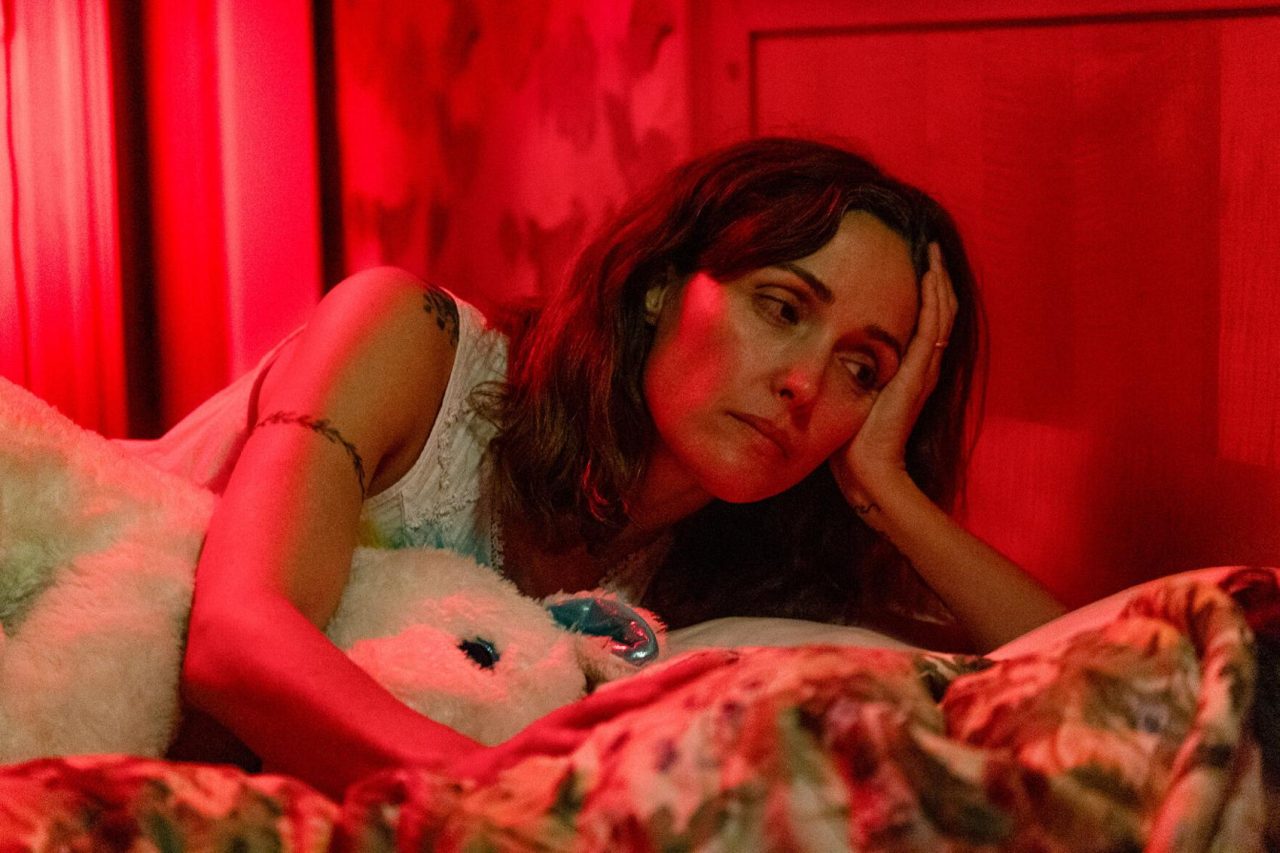
Mary Bronstein’s stress-fest second feature If I Had Legs I’d Kick You (2025) has been heralded as the mommy version of Uncut Gems (2019). Howard Ratner (Adam Sandler) of Uncut Gems constantly defers repaying the debts he owes, infuriating his family and business associates as he makes parlay bets and parades an ill-gotten black opal around Manhattan’s diamond district. In If I Had Legs, Linda (Rose Byrne) is strung out on Long Island, living in a hotel with her sick daughter after a water leak breaks a hole through their apartment ceiling. She deals with wayward therapy patients, attends her own therapy sessions, pours food replacement sludge into her sick daughter’s feeding tube, quarrels on the phone with her husband, and drinks a lot of white wine. Pitched correctly, it seems, dropping an unwell child off at an outpatient clinic or dealing with house renovations is just as stressful as a high-stakes gambling addiction.
The films both have quasi-mystical central objects of fascination: the titular uncut gem and the ever-troublesome ceiling hole, each of which are introduced pre-opening credits. In Uncut Gems, two miners in Ethiopia slip away as panic after an accident overtakes their worksite, taking the opportunity to procure the large black opal which will soon be transported to Howard. As they stare at an exposed piece of the opal, the camera moves in, entering the stone, whose insides morph from iridescent crystals to polypus and fleshy as the camera zooms out to reveal that we are looking at a colonoscope’s view of Howard’s lower intestine, the interior of the gem having transformed into his literal insides. In If I Had Legs I’d Kick You, after witnessing the initial gush of water that breaks the hole through her ceiling, Linda rushes off screen to get herself and her daughter out of their apartment. The camera presses into the freshly opened aperture, entering not an upper unit, wall cavity, or other adjacent chamber, but a dark, organic tunnel with a shimmering light at the end. We hear a heart beating and Linda talking to her therapist (Conan O’Brien) as we move closer to the end of the tunnel, before their conversation is broken by a shriek from Linda’s daughter and the camera rushes backwards, cutting to the title card. Where does the tunnel lead? Maybe the other end is the feeding tube, and we would emerge in the daughter’s stomach; maybe we would meet a blockage. The hole has possibilities, none of them good, at its other end.
These formally twinned introductions are a clue into the differences between the frenetic anxiety of the two films, and the unique affordances of the hole versus the gem. When the miners, Howard, or pro-basketball player Kevin Garnett (playing a fictionalized version of himself) stare at the black opal, they see flashes of their lives so far and feel emboldened with possibility. As Garnett so quotably puts it after Howard first presents the opal to him, “Why the fuck would you show me something if I couldn’t have it then?” The gem is all gut feeling, which the camera affirms by taking a colonoscope’s vantage. The hole is a different story.
While transiting the hole, we hear Linda tell her therapist that “nothing is familiar or real, ever. Every time I feel this way I get further and further away from being myself and, like, I can never get it back.” Linda does not have clear visions of success when she gazes into the hole. Instead, it reveals different things on each of her nocturnal field trips to the ruined apartment. She skulks back one night to review the repairs that are supposed to have been made and sees the hole emit a lightly glittering dust. Not gifted with flashes of divine inspiration à la Gems, Linda asks the shimmer a single-word question: “Mom?” The hole answers, possibly in the affirmative, by blasting out a bright white light. Is the hole a manifestation of Linda’s mother, come to relay some oblique message?
Shooting out light, breaking water, emitting a shimmering blackness, oozing goo: the seductively gaping maw is inviting us into an easy, familiar acceptance of the monstrosity of vaginas, and, as such, mothers. But this isn’t a straightforward haunted house manifestation. Later, Linda brings hotel employee Jamie (A$AP Rocky) with her to see the hole. Jamie drags on his joint and gives the hole blowback; the smoke rises into the space above the hole, which twinkles in reply. Sufficiently piqued, they go to view the hole from above. As Jamie hazards that the hole wasn’t made by a burst pipe, and that he knows someone who knows someone who could fix it, Linda stares into the hole. She sees a projection of herself in harsh, shaky close-up, holding her screaming and writhing daughter as doctors attempt to insert the feeding tube; a tear prickles out of Linda’s left eye as the doctors yell that she is not holding her daughter tightly enough; her daughter cries out for her mommy. This vision is broken by the sound of breaking wood. The hole is no longer a peephole into Linda’s moment of great maternal shame, and Jamie has fallen through it into the apartment below, breaking his leg. The hole needs both structural and psychic repairs: Jamie may know a guy who knows a guy who can do drywall, but Linda doesn’t have the capacity to resist the thrall of her failures.
The rendering of motherhood as self-abasement in If I Had Legs I’d Kick You inaugurates the film into a vast canon featuring moms on the edge. A contingent of these films play the stresses of motherhood for laughs: I’m thinking, in particular, of the Bad Moms franchise, or the Sarah Jessica Parker vehicle I Don’t Know How She Does It. Given Byrne’s adjacence to stressed-out momcoms—perhaps most notably in her turn as perfectly coiffed second wife and reviled stepmother Helen in Bridesmaids—her presence here leads me to read If I Had Legs I’d Kick You as an agitated and unsatisfied counterpart or rejoinder to these films. When Mila Kunis or SJP say fuck the bake-sale and the PTA and the stay-at-home-moms, the other moms in these films sometimes arise and say yes! I will no longer live under the tyranny of perfection! We in the audience are also invited to join in and say yes! solidarity to all moms the world around who buy pie at the store and guzzle wine!
But the scenes in If I Had Legs I’d Kick You that rehearse these beats are neither triumphant nor played for laughs. During a group therapy session at her daughter’s clinic, Linda overfills her plate with doughnuts and sticks her finger in the icing on a sheet cake with “its not your fault” [sic] written on it in sickly green cursive. She glares at the other mothers, cringes as Dr. Spring (Mary Bronstein) writes “Blame + Shame” on a blackboard, and scoffs as a woman named Melanie begins to cry. Brusquely asked by Dr. Spring to share her feelings, Linda announces to the group that, actually, it is their fault that their children are sick, they should be blamed, that she will spend the rest of her life tending to a tube-feeding machine, that her child will never recover. There is no rapturous applause from the other mothers as Linda storms out of the meeting, no Spartacus-lite declarations, no nods of recognition or approval. Whether the other moms share Linda’s feelings is beside the point: there is no space here for mommy camaraderie, no rag-tag acknowledgement that this shit is hard.
The Uncut Gems/If I Had Legs comparison can only go so far. They were both produced—and in the case of Uncut Gems, co-written by—Mary Bronstein’s husband, Ronald. And sure, both films are frenetic and stressful. Linda and Howard each make compounding mistakes. But their respective intensity emerges from radical self-assurance on one hand and abject depersonalization on the other. Despite being kidnapped, beaten, and eventually murdered, Howard retains a gambler’s relentless optimism. The film itself is, indeed, optimistic by design: Howard’s final longshot parlay bet, based on a real game that took place eight years before the film’s release, was always a sure thing. Linda, by contrast, is dogged with personal and professional diffidence, frustration, and doubt. If Howard’s catchphrase and Weltanschauung is “this is how I win,” then Linda’s could well be this is how I lose: there is no respite, no end to the drudgery, and support is nowhere to be found. Linda’s “Blame + Shame” freakout has her insist on her own unending responsibility. The film’s trailer quotes a Time Out review describing If I Had Legs I’d Kick You as “a tour de force of matriarchal fury,” an assessment surely encouraged by the gaping ceiling hole answering to “Mom.” Linda struggles with the daily pressures of raising a sickly child, kept awake all night tending to a tube-feeding machine and bristling at the many warnings from Dr. Spring that treatment is not going well. I am not the only person who has found Linda’s increasingly enraged hopelessness reminiscent of Jacqueline Rose’s proposal that mothers are best understood through their capacity to fail. Yet in If I Had Legs I’d Kick You, this yen to fail is shared by the many characters who are supposed to act as caretakers. In a film where almost all characters are caregivers of one sort or another—therapists, doctors, ship captains, hotel concierges, and, of course, mothers—Linda spends most of the runtime receiving no help and offering little help in return.
Byrne’s much decorated performance as Linda is certainly centrifugal in the story of If I Had Legs, but I do not see her struggles as the turning point of this world. Her stubbornness, self-soothing, dissatisfaction, ennui, and anger are not particularly unique, but are instead characteristics shared by characters across the film. Her therapist remains cool and unfeeling even as Linda becomes increasingly agitated and demands help; Linda behaves in kind with her own patients. Dr. Spring refuses to show Linda grace. The contractors charged with fixing the ceiling have done no work; their boss informs Linda that his mother has died, and he needs indefinite time off; she is unsympathetic. She repeatedly clashes with the supervisor of the parking lot outside of her daughter’s clinic, who is enraged by Linda’s chronic double parking. She encourages her daughter to eat something, anything; the daughter expresses disgust at another child’s sickness. She argues on the phone with her husband, Charles, whose job as the captain of a luxury yacht affords him downtime which Linda is disallowed. The jobsworth receptionist at the hotel refuses to sell Linda wine on the basis that it is almost, but not quite, 2AM.
Linda spends her nights wandering the rooms and grounds of the hotel getting stoned and drunk, where a loose perimeter is enforced by the beeps of her daughter’s feeding machine, relayed via crackling baby monitor. Increasingly sleep deprived, she is unable to offer meaningful support to her patients. For some, maybe this doesn’t matter: one woman wants to gab about being banned from The RealReal and Gen-Z groupthink while Linda gives her bleary-eyed affirmations. But one patient, a new mother named Caroline (Danielle Macdonald), is in an acute state of need. Suffering feelings of rising dread and panic, Caroline feels that she cannot be away from her infant son Riley even for a moment. Riley is a silent, looming, and faceless presence in their sessions, concealed by a blanket draped over his carrier. Caroline tells Linda stories about babysitters who murdered children in their care and sends emails linking news stories about maternal filicide.
One night, Caroline calls Linda concerned that she might be worrying about her. Linda lightly scolds her for calling and confirms that she was, in fact, not worried at all. The next day Caroline is tearful and ashamed, asking why Linda had never disclosed that she is also a mother. Linda rebuffs her: “This isn’t about me.” But, of course, it is, as Caroline tells her through tears: they share something, and they both know what it is to be a mother. No, Linda rebuffs again. She does not know, she cannot know without Caroline telling her. Still weeping, Caroline inadvertently quotes the group therapy cake: “It’s not your fault,” she tells Linda, “But it is mine.” Absolving Linda and accepting the weight of a permeating and absolute guilt, Caroline abandons Riley in Linda’s office, leaving the building and running away from her life. With his mother gone, Riley gurgles awake and begins to wail. No longer overdetermined by his mother’s fears, we are shown Riley for the first time: he is a baby. But for Caroline, he might as well be a feeding tube or a ceiling hole, a bottomless problem with no solution.
Throughout If I Had Legs I’d Kick You, Linda’s presence is diffuse and often non-identifiable as a mother, a wife, a therapist, a person, shown in sleepless close-up stumbling through adjoining spaces. People she interacts with do not use her name: she is mom, ma’am, mommy, miss. This non-identifiability is most notable in scenes between Linda and her daughter, where the daughter’s face is not shown. With no returned gaze, Bronstein leaves this primary mother-child relationship formally uneven until the film’s final moments. When they cuddle in bed, wine on Linda’s breath, there is a slow zoom into her daughter’s ear as they sing Harry Nilsson’s “Think About Your Troubles” together. Like a mangled take on Mulvey’s male gaze, Linda’s mother’s gaze slices her daughter into body parts to be dealt with not as objects of desire but ones of anguish, failure and guilt. During a breakfast scene, we shot-reverse shot between Linda in close-up and her daughter’s hands ripping up pieces of sausage and stacking portion packages of Smucker’s jam. As the daughter waxes on her desire to own a hamster, the camera lingers on the Smucker’s stack. Later, a bribe goes awry, and Linda is forced to buy a hamster. Hotel-bound with the hamster in tow, she watches in the rear-view mirror as it pokes its head out of a cardboard box and exposes its frightful rodent tonsils in a hateful shriek. When the hamster—possibly named S’mores; more troublesome food—escapes its cardboard box and immediately gets squished by a car, it feels like a relief. But the quick cut from flattened hamster to a close-up of Linda’s shock to a congealed microwavable lasagna squashes any feelings of respite and is a nasty reminder that our troubles haven’t dissipated.
Linda is placed into dialogue with the supposed objects of her problems—the hole, the tube, food of all kinds, the doomed hamster—rather than her daughter. Like roadkill transmogrified into gungy pasta, these objects replace one another. Both she and her daughter are ejected from the outpatient program following her Blame + Shame outburst: Linda for being uncooperative, and the daughter for failing to put on enough weight. Linda finally decides to take things into her own hands and pulls the impossibly long feeding tube out of her daughter’s stomach while she sleeps. Dr. Spring had told Linda that the entry point for the tube would simply close by itself after the tube was removed. It sort of does. At first, the tube hole and the daughter’s navel are like fraternal twins, two eyeless sockets. This new hole doesn’t shoot out light or a dusting of glitter, just weeps a viscous reddish drainage. The camera tightens on the hole as it undulates, grumbling and contracting into a sly wink of not-quite closure. Linda rushes back to the apartment to check on the original hole, and finds that her husband Charles (Christian Slater) has returned, still in full yacht captain uniform, and has easily convinced the contractors to do their job. The ceiling hole is gone, the problem solved; but the second hole peeping out of their daughter’s abdomen is a quick replacement, waiting back at the hotel to be discovered by Charles.
What would I see in the great gaping hole, if my ceiling were to suddenly fall down? Would I see my greatest troubles, all my abject failures? What did the hole show Charles? I wonder if it was something like what Howard or the miners or Kevin Garnett saw when they gazed into the gem: the possibility of life, and of triumph, or working hard and sorting things out, of closing the hole. As much as If I Had Legs I’d Kick You is about motherhood, and the specific difficulties Linda has with her daughter, I feel that it’s more broadly about the intense difficulties of caring for anything besides oneself. Linda cannot bring herself to concentrate directly on her child. What happens when guardianship becomes displaced? Linda’s abandonment of her child is sometimes physical. But even when they are together, she is convening with something else, like a pair of hands or a hamster or a stack of jam or a feeding machine.
At the film’s close, Linda and her daughter’s eyes finally meet, and we are given a full view of this bottomless pit of anxiety and need. There is something like a truce in their eye contact, in a shot-reverse shot that centers Linda and the daughter, each in their own frame, both in medium close-up. In these final moments, Bronstein gives both Linda and the daughter a shot at being people.