
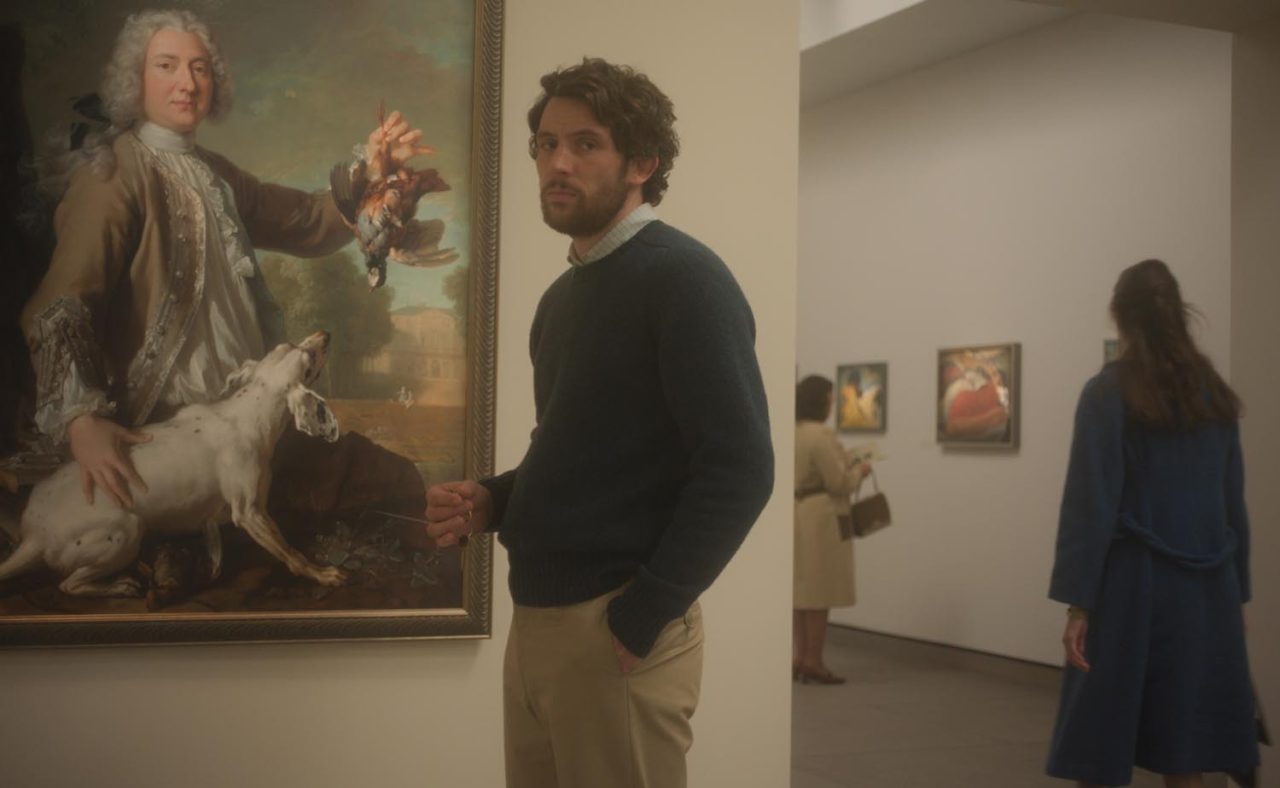
“Weird time, huh?”
Guy, J.B. Mooney’s unlikely partner-in-crime, could be referring to a few different things here: the vomit Mooney’s youngest son just spewed onto the pavement, the art heist the two men just pulled off by the skin of their teeth—or the inescapable civil and overseas turmoil of 1970.
But if Mooney (Josh O’Connor) has an opinion on any of these subjects, he doesn’t show it. He offers only a noncommittal nod, his mouth pressed into a tight-lined grimace. It’s an expression the audience will get used to seeing, the physical embodiment of Mooney’s total disinterest in the outside world. Throughout The Mastermind, we see a country swept up in protest and fervor—every television screen tuned to Vietnam, every gaze split between the news and the day—except Mooney’s. The only time Mooney picks up the newspaper, it’s to look for his own face.
Kelly Reichardt’s ninth film, The Mastermind, is her most ambitious yet—a period drama that’s been described as both heist and anti-heist. The Mastermind explores many of the ideas Reichardt’s been interested in since the beginning of her career; failed subterfuge, male desperation, escape. Like the radical environmentalists of Night Moves, Mooney’s ambitions outpace his intelligence. Like the disgruntled artist at the center of Showing Up, he has little charm to rely upon. Mooney is an art school drop-out and underemployed architect living with his wife Terri (Alana Haim) and their two young children in Framingham, Massachusetts. Terri supports the family and raises the children, leaving Mooney with ample time to plan a robbery at the Framingham Art Museum of four paintings by abstract artist Arthur Dove. Though he successfully escapes with the paintings, Mooney is almost immediately clocked as the lead suspect. He flees with little regard for the family he’s left behind.
Looming in the background of Mooney’s midlife crisis is the Vietnam War, the first war to be heavily televised. That reality is claustrophobically inescapable in The Mastermind. Televisions are tuned to Walter Cronkite. Amidst the newsreels are protestors on every street corner, veterans in buses and bars, Nixon posters in storefront windows. Mooney, either desensitized to the torrent of visual imagery or simply immune to the experiences of other people, doesn’t engage. Everything just gets his same nonchalant nod, his same half-hearted smirk.
Mooney’s apathy would seem tragic were it not so relentlessly, consistently pathetic. “I know it doesn’t make much sense, but everything I’ve done, I’ve done for you and the kids,” Mooney says to Terri, before hastily reassessing, likely rethinking his strategy as he’s about to try to bum some money off of her. “And me, yeah, me too…” He corrects himself, “Three-quarters of the things I’ve done were for the good of the family.”
Is Mooney’s selfishness normal Boomer male behavior? Is it the deep-seated depression of a man out of work? Is it the existential crisis of an artist unable to create and surrounded by images of destruction and chaos? Or is it just pre-digital brainrot and affluenza, a case of a man born with too much of everything and poisoned by nonstop violent mass media?
The only time Mooney offers an opinion on Vietnam is a dismissive comment about the commune that Fred (John Magaro) urges Mooney to consider as an escape. “What’s he got there, a bunch of draft dodgers?” Mooney laughs, as though “failed art thief” is the noblest profession. “I don’t think I’d do well in another country,” he adds, like everything is going well for him stateside.
Narcissism and pride are Mooney’s fatal flaws, traits he shares with the blowhard father he can’t stand. He’s shameless about asking for money from both his mother and his wife, and contributes little to childcare or housekeeping. It’s 1970, only seven years out from the passage of the Equal Pay Act which made it illegal to explicitly pay women less for the same work as their male counterparts. It’s almost unheard of that Terri would be the breadwinner for this white middle-class family, and given the little we see of her office, it’s clear she’s not a major executive. Mooney may not resemble the violent antiheroes of 70s movies, but his casual, buffoonish selfishness is so obvious that it’s unsurprising when he mugs an elderly woman. He’s not a comic book villain or a chaotic anarchist—just an opportunist.
“The idea of a new college graduate lounging in his apartments’ swimming pool without fear of a ‘Greetings’ letter from his draft board, as the protagonist Benjamin Braddock does, was quickly becoming an anachronism,” Beverly Gray writes of the The Graduate, in her argument that the film’s escapist politics make it a quintessential movie of the Vietnam era. Though Mooney is at least a decade older than Benjamin, his father’s status as a respected judge makes it unlikely he would ever have had to face the realities of conscription.
*
The Mastermind joins a genre of movies about a personal, somewhat petty, existential crisis within a literal existential crisis. Sure, experiencing crises within crises is the normal state of living; it’s the scale within the crises that make these characters feel particularly obtuse. This year’s Sirât explored a similar theme, in the context of a group of European ravers wandering the Moroccan desert in search of the next big party, seemingly oblivious to the unnamed crisis brewing around them. Felix, of Christian Petzold’s Afire (2023), is a proto-Mooney, his foot-stomping rage over his dull second novel comically childish set against the forest fire around the free vacation home he’s gotten access to.
Think also of Michael Haneke’s Happy End (Haneke, after all, is one of our consummate observers of the relationships between wealth, media, and narcissism), or Lars von Trier’s Melancholia: movies where the looming disaster is merely the backdrop, until it suddenly isn’t. The stubborn obtuseness to observe the end of the world is not restricted to film: the unnamed female protagonists of Ling Ma’s Severance and Ottessa Moshfegh’s My Year of Rest and Relaxation likewise feel in conversation with Mooney, even if their motivations are different.
The Mastermind doesn’t tell us if Mooney was always like this. Maybe Mooney’s case is an extreme version of ennui, a natural apathy that happens as you age and get bored and let your world grow smaller. We get a few hints at Mooney’s early life—his unfinished art degree, his relationship with his former advisor and now-fence who owned a Dove painting. He’s most animated when he’s reveling in his crime (Rob Mazurek’s jazzy score smartly accelerates with “the score”). Mooney doesn’t hide his pleasure at Fred being so impressed by the crime, though Fred interprets the theft as a larger political statement, perhaps akin to his decision to embrace life as “country folk.” It’s Fred’s wife, Maude (Gaby Hoffman), joining the long Reichardtian tradition of scene-stealing canny women, who sees through Mooney and clocks his motivations as self-interested.
So: was Mooney always a cynic, or is he another American disillusioned by a life that feels increasingly pointless? In 2025, it’s easy to explain away laziness and apathy as part of a vague practice of ‘self-care.’ Most of us make some kind of Mooneyish bargain in our daily lives for the sake of convenience. I look back on my own youthful political optimism not with disgust but with genuine confusion.
*
J.B. Mooney, art thief and art school student, seems to have little actual affection for art. Mooney might consider himself an artist, and claim that his specialization in high-end, customizable Japanese cabinetry makes him unsuited for the drudgery of administration and business management—but his home is completely generic and boring. After his theft, we only see Mooney observing art once more: the kitschy hotel art of his boarding house that he looks at briefly after peering through through the window to watch the neighbor’s television playing the news.
Paintings, warfare, protest signs: it’s all become a dull stew of visual noise to Mooney. Visual media has collapsed. War footage is just another thing to consume; art is just another commodity to steal and sell. The upbeat pop music playing on the radio in the car he hitches a lift from is indistinguishable from advertising jingles. When Mooney hangs one of the stolen Dove paintings above his couch, its swooping modernism at odds with the mundane suburban beiges of the living room, it’s hard to tell if he is even capable of perceiving the piece as art, or if he is just enjoying owning something secret and precious.
Reichardt doesn’t investigate why Mooney blows up his life, perhaps because the answer is always evident. Her frame demands an obvious parallel between his tragedy of errors and the United States’ failures in Vietnam. “Honestly, I don’t think you’ve thought things through enough,” is a recurring sentiment directed at Mooney. But his behavior is air-tight if you recognize that his primary motivation is to do what he wants, and that he has little regard for the feelings of other people; a vast but not entirely inaccurate oversimplification of much of American foreign policy. Ironic that just as Mooney embarks on a second bungled burglary, he is confronted by a looming image of Richard Nixon. Watergate might be referred to as the great loss of America’s innocence, but the almost million and a half dead in Vietnam had something to do with it.
Befitting the Vietnam metaphor, Mooney’s story ends in chaos and uncertainty. Reichardt’s ending confirms what everyone has been saying throughout the film—that Mooney hasn’t thought anything through, or that he’s been “floating” through his decisions, as Fred warned him. Reichardt’s never been a moralist, but The Mastermind is another incisive study of choice and the refractions of consequence, a reflection of how long we’re willing to submit to our own apathy.