
partial.
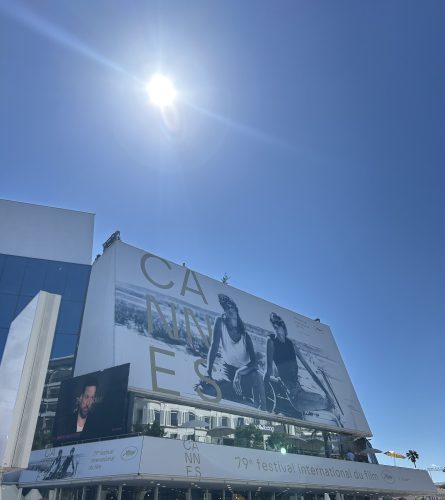
My first day at Cannes, I see nothing but the sea. I’m missing the premiere screening of Konstantina Kotzamani’s Titanic Ocean—an Un Certain Regard pick that sees would-be K-pop idols train to become professional mermaids. Friends waited in line for an hour to get seats in the balcony of the Debussy, a quintessential venue in the famous Palais des Festivals. There, over a swell of red velour, they watch the cast watch themselves on screen.
I never make it to this particular vantage point. In fact, I never make it to many screenings at the twelve day festival, having turned up for only the last seventy-two hours on a 3 Days pass, and then been incapacitated by illness for roughly eighteen of them.
This absence, more than the crush of the Palais’ coveted premieres or the recycled air of the Arcades Competition reruns, seems to be the fundamental condition of ‘seeing’ at Cannes: partial, obstructed, missed. Even critics present for the full multi-week marathon tell me they’ve sought out spells of some more private darkness: drawing the shades of a hot hotel room to avoid the new Nicolas Winding Refn-like midday UV rays, or the plague. Nor does making it to a film guarantee you’ll see it clearly. Another writer catches the premiere of James Gray’s Paper Tiger with an eye toward the back of Adam Driver’s head. Is he enjoying it? Nothing arrives unmediated: we see through others’ seeing.
To some degree, this imperfect attention is the nature of seeing at all film festivals. Their glut makes sustainable consumption nearly impossible. But Cannes’ position in the global film market, not to mention the globe writ large, lends a different tenor to every skipped line or slept-through screening. There is the misplaced sense of here or nowhere; a feeling of first-ness that many flew across an ocean to indulge. The festival’s prestige, combined with its timing—inaugurating the European festival season—lends a bucket list quality to every film, though many will be available in theaters near you come fall.
It doesn’t really change anything to know that. The urgency is embodied, the same fierce warmth as too much sun. My friends tell me Titanic Ocean is terrible; online, folks drop tickets like flies. I watch the Mediterranean until the glare gets blinding. Then, for just a moment, I close my eyes.
obstructed.
The second film I don’t see at Cannes wins the Palme d’Or.
At least I’m not alone. Outside the Arcades, a utilitarian haunt where many of the non-industry accredited catch back-to-back showings, all hell breaks loose over transferred QR codes. The 3 Days cohorts—resembling nothing so much as film school spring breakers—have been bartering these like strung out traders on some ersatz stock exchange: anybody got a teenage sex and death???? offering a hope for a minotaur. As a result, Cristian Mungiu’s Fjord becomes not unseeable, but unscannable. Barcodes on the fritz as frantic lines welter in the sun.
That exchange value should accumulate faster than Letterboxd ratings isn’t surprising for a festival that is, above all, a marketplace. Films premiere not just to be seen, but to be sold. The gamble taken by distributors like Neon, Mubi, and A24 is echoed in smaller mint by audiences, who are, among other things, betting on seeing the next big, best—or at least mildly interesting—thing. The economy becomes temporal and, as ever, attentional. Neon, which has distributed the last seven Palme winners, banks another sweep. Meanwhile, Fjord-less, I book it to the first screening of Maria Martínez Bayona’s The End of It, a Cannes Premiere selection I hadn’t heard of until seventeen seconds before I got the ticket.
I hate it. But, also, I’m glad to see it. Starring Rebecca Hall as a performance artist who has chosen to die in a world where death has become optional, the film enacts the same thing it produces: a desire to leave. At Cannes, this desire feels like no movie walk-out urge I’ve ever felt before. I wonder, repeatedly and with an intensity that has almost never come to me in another theatrical setting, if I should sneak a peek at my phone—not just to clock my own countdown, but to see if it’s possible to swap for a screening of the new Quentin Dupieux. an end for a vertiginous???? a waste of ninety minutes for a safer bet???
But I stay. I stay because, ultimately, the discomfort is gratifying, utile. I stay because I know already that I will write some version of what I’ve written here, even if I am missing films that might better serve—in what way?—me. I am drafting more than I am watching, though I don’t actually touch my pen, or my phone.
When Hall’s Claire, buffeted by a deadening sense of bad comedic timing, starts a countdown to the moment she’ll publicly kick the bucket, we are all waiting for it to be over. There is a throwaway moment where, as she dies, her fans do not know whether or not to applaud. Here, in the home of the standing ovation, in an audience that has visibly thinned, it lands like a jump scare, like a punchline, like an essay’s perfect illustrative beat. Just then, I wouldn’t trade it for anything.
missed.
I ask other critics, “What can’t I miss?” The answers aren’t surprising—the Hamaguchi, the Jude, the Harari—but they’re also not answers, really. I can, as I’ve said, miss almost anything. A minute of a lulling ACID pick, as I fall asleep. All of the Hamaguchi, which I looked forward to for weeks, and then at the last minute swapped for the new Ira Sachs and The Black Ball by Los Javis. Two for the price of one, etc: I’m already spent on this metaphor.
We are all of us at Cannes looking forward to—as in directionally—something. We watch toward an essay, a dispatch, a podcast, a Haiku on the back of a receipt. I swap the film I know I’ll enjoy for the Sachs and the Spanish drama, because I’m trying to stay abreast of late festival premieres. I’d like to have something to talk about on the critics roundtable I never make it to.

Consensus is one of the other things on trade at Cannes. It invites not just comparison, but constellation: you arrange yourself in relation not to film objects as such, but to film objects as discourse. You follow a beat. You fire up a hot take. You seek subtle connections which become defining characteristics: this is, for instance, by most accounts, the worst Cannes in recent memory. That it is the only Cannes in my memory does not make this less true—oddly, it makes the idea of trucking from Parasite to Portrait of a Lady on Fire feel more visceral, like hearing someone describe a real rollercoaster that mimics the same drop you’ve only felt in a dream.
I do make it to one unmissable film: Arthur Harari’s The Unknown. That it is at once one of the most discussed and the least describable films in Competition suits. (“It’s divisive,” a bevy of wonderful critics all wholly agreed.) Following Eva (Léa Seydoux) and David (Niels Schneider) as Parisian loners existentially unmoored by a body-swapping STD, it teases at allegory while refusing to own one cleanly. It leaves available a perilous multiplicity. It avoids the trap of language, where to choose one word is to dismiss another. You’ve made meaning and foreclosed it, simultaneously. There’s less to talk about the more there is to say.
This, too, is the condition of festival-speak. I pick some films over others because the framework of my experience is not experiential; it is exegetical. I organize myself around opinions I am going to have about things I have not yet seen. In The Unknown, there is a sequence where the film we’re watching is replaced by another film, one we don’t yet know we’re watching. When we’re made to understand this—pulled back to find David-as-Eva looking at a laptop—it creates a doubled moment of recognition, another recursion. David-as-Eva identifies him/herself for the first time only through spectatorial distance: there she is, he realizes, about the person he not only will be, but is already. We go outside the film to find that. We are still inside the film, finding that.
Surprise, then, is still available: it’s just in all the wrong places. I’m surprised after the Ira Sachs screening because all week I’ve bitched about my ambivalence toward Sachs, and then I’m still ambivalent, but also I’m crying. I’m surprised at 1 a.m. in the hotel room off the Croisette, because all day I’ve felt fine, and then I feel like I’m going to die. I’m surprised at a public screening of Pietro Germi’s Signore & Signorni on the beach, because the film is in Italian, and the subtitles are in French, and I have an American’s sense of epistemic entitlement. I’m surprised because, regardless, I find I cannot not watch it.
I’m surprised, too, because I thought it would feel different, watching films just along the Mediterranean. But in the dark, you could be on any sand. With the screen a light that could pull tides, the biggest thing in Cannes is just a gap before the yachts begin. You look at it. Then you look back at the movie. Really, there’s nothing else to see.