
Look on me. Give a look on me. Am I a Jew or a gentile?”
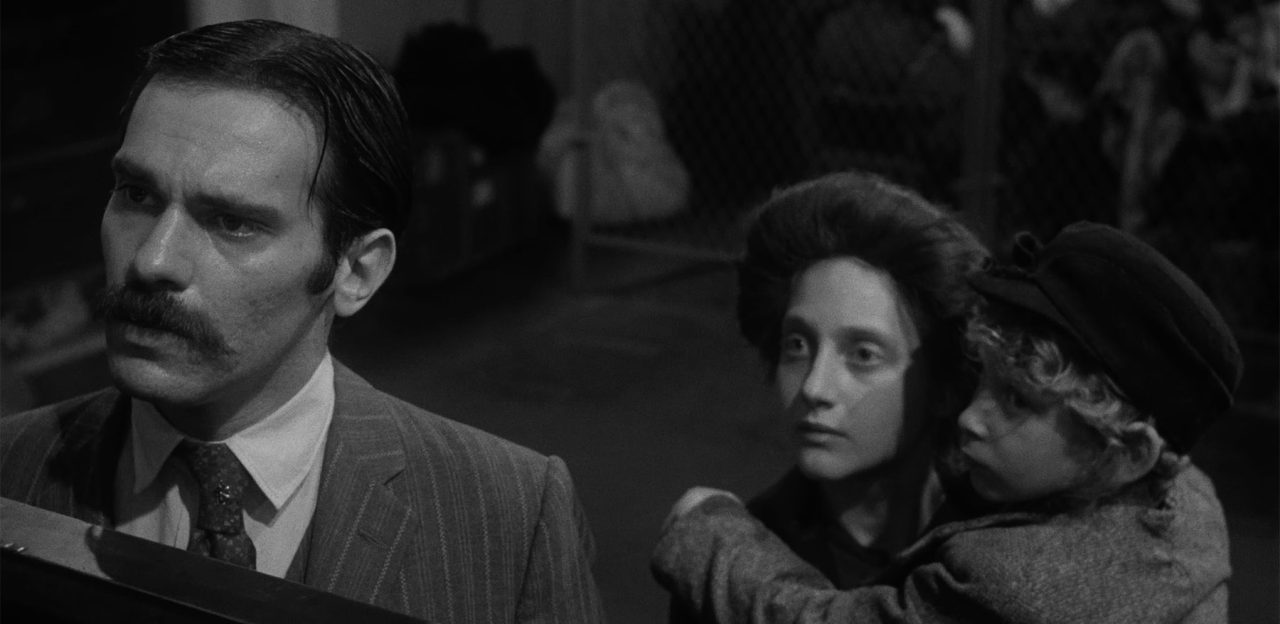
Jake, formerly Yankel (Steven Keats), asks this while standing proudly in a park. He’s posing the question to his wife, Gitl (Carol Kane), and Mr. Bernstein (Mel Howard), who lodges with them in their New York City tenement. Jake asks his question—does he look like a Jew or a gentile—while the three are out for a day of picnicking and playing with Jake and Gitl’s son, whom Jake calls Joey and Gitl calls Yossele. Mr. Bernstein is teaching the child Hebrew letters. He is also an immigrant, but he is not like Jake—he used to study Talmud and, though he now works in a sweatshop alongside his roommate, he still reads and writes his religious texts at home. He does not yearn to be a Yankee. “When you get on the boat, you should say, ‘Goodbye, O Lord, I’m going to America,’” Mr. Bernstein tells Gitl shortly after she arrives.
Jake came to the United States first, without his wife and son. He made himself “an American fella,” as he puts it. “A Yankee.” He changed his name and how he dressed and carried himself and shifted his manner of speaking, putting on a kind of idea of a New York accent. He doesn’t wear a kippah or peyot (long sidelocks) or sit in the evening studying. Instead, he dons slacks and caps and goes out dancing. And, with his wife across the sea, he chased after Mamie (Dorrie Kavanaugh), a fellow Jewish immigrant, but one who makes sure to dress and speak and save money like a modern woman. She speaks (hard won) English, not Yiddish. Her hair isn’t covered. Gitl, at one point, says she thought from her outfit that Mamie was nobility with her hair done up, befeathered hat, waist pulled in, and expensive looking dresses and blouses.
But when his father dies, Jake brings his wife and son over to the United States to live with him. So begins a cultural, familial, and deeply personal clash: Jake resents not only that his wife complicates his relationship with Mamie, but that her Yiddish, her sheitel, her clothing, and her otherness in America are an unwelcome reminder that, no matter how hard he tries, he will always be other, too.
Before making her 1975 feature directorial debut, Hester Street, Joan Micklin Silver had been researching stories of immigrant assimilation for an educational short, The Immigrant Experience: The Long Long Journey (1972), when she came across a 1896 novella by Forward founder Abraham Cahan called Yekl: A Tale of the New York Ghetto. Cahan, himself a Jewish immigrant and a socialist, was interested in the tradeoffs people made in coming to this country, and in what there was to be lost and found between tradition, which could be superstitious and illiberal but also communal and intellectual, and assimilation, with all the individualism and shallow materialism contained therein.
The story reminded Silver of her parents, particularly her father, who came to America not knowing English when he was 12 years old. Her television producer had requested that she not write about Jews—“too atypical,” apparently—but the tale stuck with her. She adapted the story in six weeks, but shifted the focus: in Silver’s screenplay, Gitl is the protagonist, and Cahan’s treatment of women as suspicious toward and jealous of one another is replaced (Mamie aside) with a kind of quiet female solidarity.
Unfortunately, film wasn’t any more welcoming than television. It wasn’t just that she was a woman, though there was also that. (“Women directors are just one more problem we don’t need,” one industry executive is said to have told her.) It was also that the movie was so Jewish. Silver wanted to film Hester Street in black-and-white and have it be largely in Yiddish with English subtitles. Though the film industry had no shortage of Jewish executives, directors, and screenwriters—not to mention the hit adaptation of Fiddler on the Roof (1971)—by and large, Hollywood was still in the business of showing America a cinematic version of itself. Showing Jews stepping off the boat and fighting (in Yiddish) over how not just to make a living, but a life in this country, Silver’s vision was simply too “ethnic.”
But Silver was undeterred. If Gitl could make it to America, so would her movie. If mainstream studios wouldn’t make it, she’d make it herself. Silver ended up getting financing—a budget of roughly $370,000—from her husband, a real estate developer and the movie’s producer and distributor. Hester Street, an essentially self-financed, self-distributed picture, ended up making $5 million by the conclusion of its theatrical run.
Nevertheless, Silver ran into similar difficulties more than a decade later while making the 1988 film Crossing Delancey, a romantic comedy about a young uptown Jewish woman and her meddling downtown bubbe. To watch Hester Street and then Crossing Delancey is to feel you’ve entered a sort of Ashkenazi time machine, zooming forward to experience another Jewish woman’s journey of making sense of her place, her roots, and her love life in New York City.
But the success of Hester Street wasn’t enough to convince Hollywood to invest in Crossing Delancey. Neither was the fact that it was (a phrase here or there excepted) in English and in color. Nor had the passage of time persuaded Hollywood that it could make movies about explicitly, self-evidently Jewish women, or that women directors were worth investing in. One studio said she should change the family from Jewish to Italian because the tropes would be more familiar to audiences, as though people can only watch movies about people and cultures they already know. As though specificity can’t lend itself to appreciating universality. As though Silver weren’t a competent creator of characters and contexts, one who could make audiences feel like they lived in this Jewish world even if they’d never met real life Jews.
Once again, Silver stuck to her ethnic Jewish guns and made the movie anyway. She was able to secure all of the film’s financing, this time through her star, Amy Irving, who was, at the time, married to Steven Spielberg.
***
But back to the park. Does Jake look like a Jew or a Gentile? Gitl and Mr. Bernstein laugh at the very question. “Forget that you know me,” Jake insists. “Just by what you see, what do you say?”
“A Jew is a Jew,” replies Mr. Bernstein.
The outfit—trousers, a shirt, a vest, a floppy tie, markedly more casual than Mr. Bernstein’s black suit and hat—can’t change that Jake is, to them, unmistakably, unchangeably Jewish. Jake is trying to prove a point, countering Gitl who, a moment before, asked Jake, “Where in America is the gentiles?” Where they live, on the Lower East Side, Gitl remarks, “Everywhere Jews. The gentiles keep in another place, eh?” Indeed, they are literally in another place, having had to take the train for an hour to get to the park to another, greener, presumably less Jewish part of the city. Jake is trying to say that, unlike Gitl, he passes as an all-American man. But though Jake makes a point of dressing “American,” of not adorning himself with signifiers that might mark him as a Jew, his whole world, and by extension Gitl’s, is Jewish, and all of the smart slacks and caps or bowler hats in the city can’t change that. Has he, in fact, assimilated? Or is he playing American dress up with other Jews? Or both?
This enrages Jake, and he runs off to teach his son baseball, that all-American pastime, for his son will be an American boy. He first takes time to make fun of Mr. Bernstein and how unassimilated he seems, calling him a “greenie” and telling him he should settle for whatever wife the matchmaker has in store for him, no matter how hideous. Mr. Bernstein hears this and sits, sadly and solemnly. “A pox on Columbus,” Gitl says to Mr. Bernstein in Yiddish, as if to cheer him up. Briefly, it seems like this works. He is heartened by her pox on Columbus. Still, there they are, Jewish immigrants in America.
***
“Look at me,” Mrs. Kavarsky (Doris Roberts), Jake’s landlady, demands of Gitl, whom she has just caught trying to buy a potion to make her husband love her again, like he did back when they were in Europe. She needs to dress as though she lives in America, Mrs. Kaversky says. But Gitl insists she won’t be a “goyah,” not even for “Yankel.”
And so Mrs. Kavarsky insists Gitl look at her. “Am I a goyah?,” demands Mrs. Kavarsky. “I’m as pious as you, anyhow. And I go with my own hair, don’t I?…It can’t be helped. We live in an educated country, so we dress like educated people.” Mrs. Kavarsky does not cover her hair. Her clothes aren’t quite as polished as Mamie’s, but, still, she is donning sharp blouses and accentuating her waist. To her, this signifies to the world that she’s outgrown tradition; that she doesn’t need the practices and styles of her Old Country. It’s not “education” in the sense of having obtained learning in school (in fact the most learned character in the movie is Mr. Bernstein, hovering over his Hebrew letters), but it’s showing America, she thinks, that she has learned something of its culture.
Her outfits, her hair, her style—all of these have helped Mrs. Kavarsky in this country, but they didn’t take her from herself. How could they? She’s Jewish. Is that—not only her religion, but her ethnicity, her culture, her identity—really so fragile as to be threatened by some clothes? There are some who would, of course, say that yes, it is, and that it’s important to dress a certain way to hold onto Jewish tradition, and maybe to Jewishness itself. This is for religious reasons: Gitl, as a married woman, was expected to wear a wig in keeping with religious tradition, signalling that she is married and modest. And there is also a degree to which it is armor against assimilation: so long as she covers her hair, she’s dressing in a way that distinguishes her as a Jewish woman, and so is keeping her identity not only internally but physically distinct from the non-Jewish Americans around her.
Hester Street is set at the turn of the 20th century, and, in real life, the next 100 years would feature American Jews facing the same questions, wondering and worrying about what it means to be a Jew in America: what makes us different, what makes us Jewish, and whether one day we’d wake up and be gone. Social scientists and Jewish organizations fretted about intermarriage and shul attendance and growing criticism of Israel. How much can you change before American Jews stop being Jews at all?
But, at least when it comes to the clothing, Mrs. Kavarsky rejects this line of reasoning the way she does everything else in this movie: with great force. It’s only a dress. It’s only some hair. It’s enough to help you get by in America, it’s part of being in your new surroundings, but it’s not so powerful as to keep you from your Jewishness. From yourself.
Gitl eventually comes around to trying this way of thinking. One day, she smooths out her dress and waits in her natural hair for Jake to come home. She thinks he’ll be pleased. Instead, he yells at her, yanking her hair, insulting her. “It doesn’t come off!” she screams back. “It’s my hair!” Clothes couldn’t make him a gentile or a Yankee, and they couldn’t threaten Mrs. Kavarsky’s sense of Jewishness, but neither could they fix Gitl and Jake’s marriage. Jake storms out. Mrs. Kavarsky comforts Gitl, telling her he’ll be back. But Gitl says no. She doesn’t want this anymore. “I don’t want him back. Enough.”
Pauline Kael wrote in her New Yorker review at the time that the movie never showed us what might be gained by acculturation: “The film—nostalgic for what the immigrants lost—never shows us that there are grounds for Jake’s wanting to be Americanized.”
And that is one reading, since, insofar as the movie has a villain, it’s Jake, the abusive, cheating husband. But another reading is that there is perhaps not such a clean line between the Old World and the New, between rejecting or accepting acculturation, and that maybe that blurriness can both ground and liberate. Fashion, like English lessons, can help a person settle in, and it can empower, and it can help someone get to where they want to go, but it doesn’t transform a person out of who they are, just as it can’t, by itself, make our characters who they want to be. Clothing doesn’t have to mean you’re bad, so long as you remember that it also doesn’t magically make you good. In this way, it’s not unlike being American.
***
“Mr Bernstein, is all right, these things?” Gitl stands before him in her new blouse and skirt. “Mrs. Kavarsky say, for a divorce a woman must not look like an old broom.”
After his fight with Gitl, Jake ran off to Mamie, who said she’d saved up $340—enough to buy Gitl off into agreeing to a divorce. And Gitl did. But she held out until she got not the $50 originally offered, but $300. She was not as green as the lawyer had expected, or as Jake and Mamie might have hoped. She can even afford a new blouse and skirt to get her gett.
After the divorce proceedings, she’s told she must wait 91 days to remarry (Jake, of course, can remarry that same day). “She’s a good daughter of Israel, Rabbi,” says Mrs. Kavarsky. “She could marry tomorrow, but she will wait 91 days.” Still, when Mrs. Kavarsky tells the rabbi’s wife that Gitl’s son is named Yossele, Gitl corrects her. His name is Joey, she says.
At the very end, Gitl walks down the street with her new love (Mr. Bernstein, of course) and her son. They’re planning the future of the grocery store they’re going to open, here, in this country, which both took from her and taught her to give as good as she gets. Mr. Bernstein, she promises, will be able to study while she works.
She’s wearing her new, stylish, American hat, under which is her natural hair. But who would say she’s not Jewish? There she is, strolling along, an American Jew. The former half of the phrase can’t negate the latter. A pox on Columbus. Still, we are here, Jews in America.