
When Kiyoshi Kurosawa broke out internationally from the epic one-two punch of Cure (1997) and Pulse (2001), he (rightfully!) earned his name as an auteur for the cyber age: here was a director actually thinking about how people relate to each other across digital portals, a trap door that instead leads to a darker and lonelier void, and managing to capture the strange feeling of this relationship on screen. His more recent works—not to mention the 2024 run of Cloud, Chime, and remaking his own The Serpent’s Path—reinforced this idea, each exploring the capacity for technology to bring not just evil but violence to our door.
Strange as it may seem, it makes perfect sense to me that someone with that resume would feel drawn to pure jidaigeki with his next project, The Samurai and the Prisoner (2026). Jidaigeki is a genre of Japanese film/TV set before the Meiji Restoration in 1868, far away from the browser windows and cellphones that haunt Kurosawa’s films set in contemporary times. Though they can technically show the lives of anyone living in feudal-era Japan, they often focus on samurai enforcing honor, and typically build to a climactic sword fight. (The other major Kurosawa’s Shakespearean epic, Throne of Blood (1957), hangs over Samurai’s consideration of life during wartime.) The Samurai and the Prisoner is, as the title suggests, focused on a samurai who’s interested in living an honorable life—namely by trying to preserve peace and solve murders in the face of a war on his doorstep, while attempting to handle the ideological differences with those around him.
It’s a talky period drama, decidedly distinct from the grungy J-horror Kurosawa helped define. He’s expressed that he set out to make as “orthodox” a jidaigeki film as possible, hoping to restore its place in Japanese cinema a bit. But The Samurai and the Prisoner is very interested in the same ideas Kurosawa has been circling his whole career, of times changing out from under us, undermining the relationships and norms we thought we knew. And, 40 years into making films, going hundreds of years back to the past has proved to be the perfect way to show he’s in lockstep with the times.
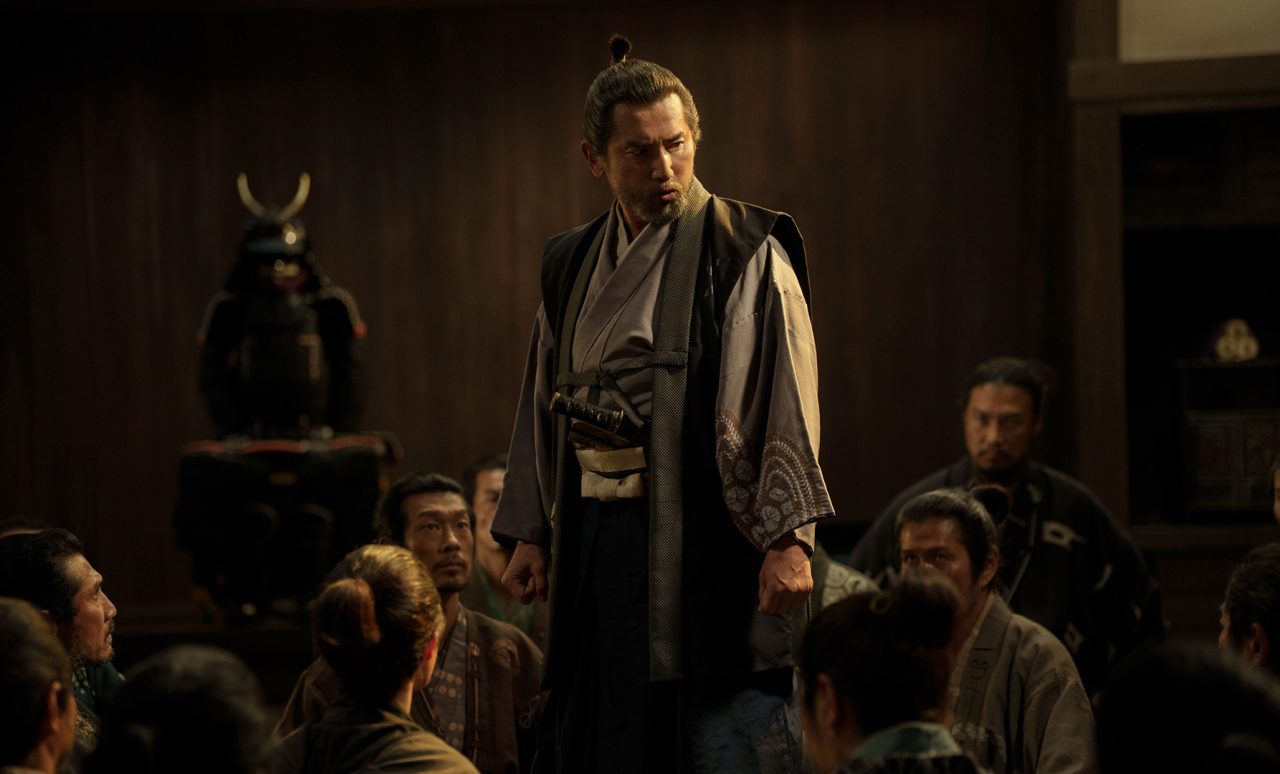
Still, if you’re used to the depopulated worlds of Kurosawa’s filmography, the look of The Samurai and the Prisoner is a far cry from his older works at first blush. His usual desolate industrial horizons are overtaken by the rich, well-maintained grounds of Arioka Castle. Where Pulse or Serpent’s Path conjure images of torn plastic and exposed pipes—Chime, the toxic sterility of modern architecture—Samurai is all crisp shoji doors near lush, perfectly manicured grounds. But that palatial grandeur belies a sense of foreboding. Set around a feudal lord, Araki Murashige (Masahiro Motoki), trapped in his castle while under siege, Samurai is tightly contained. We follow so little outside the bounds of the castle, and Kurosawa keeps a careful eye on the feeling of being enclosed with each frame. A man climbs a ladder and is forced to stop short of the sky by a platform; Kurosawa often holds cameras to emphasize how little of the room a character is utilizing. Every beautiful garden has another door, wall, watchtower, guard, or barrier to it. It may be soft and pleasing, but it’s no less a restraint.
That kind of trapped feeling is omnipresent in Kurosawa’s filmography. When Kenichi Takabe (Koji Yakusho) discovers his wife is missing midway through Cure, he takes to the streets to find her; Kurosawa holds the camera far above him, tracking his movements along illuminated Tokyo streets that seem to be the only defined paths of light in the dark of the city. It’s as if the descent has already started, and there’s no room anymore for deviation. What’s worse, it’s easy to not notice: In a Kurosawa movie, average life has been swallowed by something darker—something that flows entirely out of the eerie routine of day-to-day life. He finds the edges of normalcy and pushes them without losing a sense of the mundane (as in Chime’s family dinner, where all three seem to exist in a separate version of the meal from each other, noticing but not caring).
In the past, Kurosawa’s hypervigilance about everyday life has often been about the way technology takes up the air even when we’re not thinking about it. When Ryosuke Yoshii (Masaki Suda) starts his first auction at the top of Cloud, all you get is the hushed ambient noise of the room and the computer doing its thing. It’s not until he sells his final therapy machine that he allows himself a chance to breathe, and the score kicks in. Daguerrotype’s (2016) model is literally held in place in service of the giant, ancient technology that seeks to capture her image. The computer lab of Pulse has a distinct hum, with the beige machines taking up so much of the screen and totally defining the things people talk between, over, and around. It’s easy to see such concerns over technology seeping in through all aspects of life as the primary driver of Kurosawa’s modern anxieties. “Through the power of marketing [the internet] just spreads all over,” Kurosawa told Reverse Shot in 2005 of his work on Pulse. “I think at the time it was just kind of this unknown force that was spreading like a virus throughout the country and had that kind of ominous and menacing feel to it.”
But Kurosawa’s reputation as a master of grim technological horror elides the elasticity of his style, the way his blocking and plotting hold his characters in a vice grip no matter what genres they trip through on their journeys. Some of his most deft work is the way films like Cloud, Chime, Wife of a Spy (2020), or Loft (2005) resist easy categorization. Pulse bucks any recognizable archetypes or rhythms of a ghost story; the only thing that holds these characters is windows, which serve as both a barrier and a framing device (a further extension of the haunted browser windows taking over the world). There’s no moralizing and little announcement of disappearances. Instead, his work captures the psychological dread of something more overarching, of people standing on the cusp of changing times. It can be violent, but more than anything it’s ominous—see Pulse’s aimless drift into some diffuse, unknowable future without possibility for intervention. Like Tony Soprano, these are characters coming in at the end of something, forced to reckon or carry or even give way to the awkward rebirth of something new.
Terrifyingly, the change can come from anywhere. It’s driven by a single entity—Serpent’s Path’s revenge mission or Wife of a Spy’s rejection of nationalism or Cloud’s greedy capitalism or the Creepy (2016) neighbors, who give the movie its name—and their own sense of purpose in the world. Or it can be some invisible force, felt in the same way animals panic before earthquakes: the hypnosis of Cure, the digital new wave of Pulse, Chime’s chime. Either way, it’s inevitable. And when it comes, it’s unclear if the sudden violence swallows normalcy, or if life goes on because of violence, allowing for it as a natural release. The violence in his work is almost upsettingly dull. It’s often dispatched quickly, and one of Kurosawa’s strengths is the ability to hold the panic of those around it in the same shot in which the perpetrator seems (often) almost numb. Frequently, as is the case with Cure, there are nods to simmering resentments along personal or social lines. But that movie stubbornly refuses to identify what those things are, settling for barely explaining the hypnosis behind the serial killings. (As Kurosawa himself put it: “A part of me believes that explaining the reason for somebody’s actions is not very interesting filmmaking.”)
For The Samurai and the Prisoner’s Murashige, the reason for his actions is pretty clear from the jump—as is the ostracization he faces because of it. Murashige is disinclined to kill, uncomfortable with the ease of brutal retribution that’s so normalized around him, dedicated to sparing everyone he can, whether that’s the son of a betrayer or an envoy sent to bargain by the warlord Oda Nobunaga, Kuroda Kanbei (Masaki Suda). This goes against custom, but that’s by design; part of his rebellion against Nobunaga is a belief that the war lord’s vicious norm isn’t the only way. Kanbei’s not so convinced; as he regularly points out to Murashige, not killing him sends the message that Kanbei has switched sides, putting the son he left in Nobunaga’s camp in danger. But Murashige will not be swayed. “That has nothing to do with me! Oda killing hostages isn’t a rare thing! If that upsets you so much do something to prevent it”
Such choices are in line with jidaigeki tradition, where “good” samurai are set apart from “bad” samurai by their reluctance around violence. But there are few samurai that are outright pacifists in the way Murashige is. Harakiri’s (1962) Hanshirō is still decidedly after violent retribution, even if he exercises it mostly as a means of teaching lesser samurai about the weight of violent conflict. The closest might be Zatoichi, the protagonist of more than 25 films and 100 TV episodes across decades; but while he had (for the most part) given up his life as a swordsman, it’s also often used mostly as a means for the story to delay him dispatching his enemies. Murashige goes further than both these men: he’s so deeply opposed to the idea of violence that he refuses to kill when it might benefit him, or even be totally understood. And yet he seeks to hold onto his power as a samurai and leader of men.
And so Samurai’s entrapment feels twofold: there’s the literal cost of war, a siege, and then there’s the mysteries that keep popping up around Murashige’s domain. First it’s the murder of a boy in his care; then it’s a swapped head; next, a killed emissary and stolen tea urn; and later, the “divine retribution” visited down on the perpetrator. With your Columbos, your Sherlock Holmes stories, even your Dragnets, much of the story is built from the challenge of the riddle itself. But here, each mystery isn’t so much a perfect crime as it is illuminating a blindspot for Murashige. As a leader, he is resolute in living his truth, and so he can’t see the way desperation corrodes hierarchy and honor alike. He cares little for external perception of his actions beyond hoping that they inspire other men to follow in his footsteps. And so he can’t see how sunk in everyone around him is to their own frame of reference. If there’s a price for change, he’s willing to pay it, even if it costs him his reputation.
The film’s placement of Murashige as a man out of step with his time is perhaps most reminiscent of Kurosawa’s Wife of a Spy. Yūsaku Fukuhara (Takahashi) is similarly a man rebuffing the norms crystallizing around him, preferring Western clothing or imported whisky, and enjoying close relationships with foreigners in an increasingly Imperially-minded Japan. Things spiral when his wife Satoko (Yū Aoi) finds out he brought back evidence of Japanese war crimes from a business trip. Yūsaku defends himself as having a moral imperative, not as a spy for the Allies, but as a righteous knight of virtue: “My allegiance is not to a country but to universal justice.”
This is not received well by Satoko, who didn’t see the biological experiments he did and worries for both of them in the face of his unequivocal moral calm about Japan’s chances in the war to come. Her concerns are the crux the movie pivots on: when he asks her if their happiness is worth it even if it comes at the price of cruelty, she flips his resolve back at him, avowing that she’d “still choose happiness.”
Her change of heart comes after she sees a film reel from the labs. She quickly makes three key decisions: that righting this cruelty is her husband’s future; that she wants to be together with him in it; and that, like him, she no longer believes that anyone’s happiness is worth more than that, selling out his nephew to provide them some cover. In the end, those beliefs will be her undoing; Yūsaku leaves her behind—maybe to protect her, maybe to help cover his own escape out of the country with the evidence. Either way, she’s left to answer for the changing times. But even when she’s left in a sanatorium five years later, she refuses help to get out. To her, she’s the only sane one left in a country drunk on patriotism and military might.
It’s an interesting parallel to Samurai’s married duo, where Murashige’s wife Chiyoho (Yuriko Yoshitaka) is in lock step supporting her husband’s actions right up until she’s not. As he finds out at the end of the movie, she’s the one who’s been behind every single plot. Having lived through the siege of Nakashima, where the Japanese Buddhist teaching of “advance to paradise, retreat to hell” caused a massacre, she hoped to prove that even the meek could find divine retribution. Like Yūsaku and Satoko before them, their morals at once do and don’t overlap. They all attempt to embrace a brave new world and push their country to a better place. But it comes as an abnegation of Murashige’s example; proof, perhaps, that his mission is and always has been foolhardy—that the only thing he has inspired is some Macbeth-esque string pulling to maintain his delicate heart. His reputation, his goodness, was too innocent to be true.
Such is the pessimism of Kurosawa’s recent output: each seems (to twist a phrase) to advance stories only to show how readily hell might be reached. While the violence and mystical forces in Chime seem dreamy, marked by a glinting of a passing train car, it stubbornly refuses to break the spell. Serpent’s Path leaves Sayoko (Ko Shibasaki) staring cold and steely eyed over her laptop as she realizes the depth of betrayal that cost her her daughter. And as Satoko sees the ultra-nationalism of Kobe literally crumble and burn around her at the end of Wife of a Spy—the thing she’s ostensibly been working and waiting for—all she’s left to do is collapse on the beach to scream and cry by herself in the gray.
That despondency is shot through his films, but they haven’t always been quite so bleak. In the 25 years since Pulse came out (or even the decades since the internet went mainstream) no one has come up with a better metaphor for life on the internet than Kurosawa did from a time when people might’ve still actually read the user agreements they had to sign to use the web. Inside a university lab, a grad student’s simulation is designed (on a computer, of course) with a bunch of fuzzy dots against a black background. “If two dots get too close, they die,” one student explains to another, “but if they get too far apart they’re drawn closer.”
It’s possible to read Pulse’s ending as a tragic extension of this, some forever dance that has thrown society into a complete chaos and sees Michi (Kumiko Asō) losing her only remaining friend right at the moment she’s expressing gratitude for having found him. But there’s a certain optimistic wistfulness to the desolate post-apocalypse. “I think the vague idea I had at the time was that we were really on the cusp of a new century,” Kurosawa told Reverse Shot later. “The idea was to abandon, by destroying everything from the 20th century in order to head into a good, new future. It wasn’t that the apocalyptic vision was negative or despairing, it was positive, a way to get rid of old baggage.” Stripped of horror movie logic, Pulse allows for ruefulness to sit alongside a certain trust in something good to come of all this, any of this.
The same is not true for Cloud. While our protagonist has survived the day, rescued by his (presumably) massively underpaid assistant-cum-possible-former-mob-guy, the two drive off less in peace than in chilling calm. Ryosuke is despondent over all he’s lost. The sky beyond the windows of the car is sickly yellow-green, taking on an almost mythical doom feeling that activates the same lizard brain as a hurricane. As Sano (Daiken Okudaira) gleefully promises him everything, “even things that can end the world,” the weight of his actions suddenly washes over Ryosuke: “So this is how you get into hell.” Cloud, despite its uncanny atmosphere, seems clear-eyed that the hell is one borne out of something much more mundane. To this movie, the internet isn’t something that holds potential for much beyond scamming and the amplification of violence. Whatever Kurosawa hoped we could restart the new millennium with is no match for the more ancient evils of the mob, capitalism, or arguably hiring the literal devil as your enabling assistant.
After decades of making movies and dozens of pictures, it’s no surprise Kurosawa is reevaluating the moral arc of the universe. (Who isn’t!) It’s exactly what makes Murashige such an interesting protagonist for this moment, eager for power and peace in equal measure. So it’s notable that, after discovering Chiyoho’s betrayal and hearing her confession, he doesn’t pick up his sword in jidaigeki fashion. He just descends to the most important room of all.
The subterranean cell holding the titular prisoner, Kanbei, is a room totally unlike anything else we see in the movie—rolling, mossy stones making up the base of the prison cell give way to hard support beams; it’s an irregular shape where the rest of the Murashige’s house is all clean right angles. It’s the only set built for the film (amid some five castles that make up parts of Arioka Castle we see throughout the year the movie takes place), and yet still seems to carry the same weight of history as any of the above-ground locations or warehouses Kurosawa favors.
The space itself is a warped version of Cure’s cell, where two men at odds similarly swap places and push past defined frames. While Takabe loses ground to his mesmerist, the power balance between Murashige and Kanbei isn’t as easily directed. Most times the person in power is the one who’s standing, but sometimes it flips. Even when the cell door is left open, the walls of the cell keep things feeling bottled up. As Samurai’s pair bandy about their mysteries, the demands of leadership, and their hopes for the war or the world, the quiet underground feels telling, all roots and exposed beams that feel like they’ve stripped the world back into what it was. The nonuniform space feels ever-shifting, with equal potential to be heaven or hell. So it makes sense that it’s here that Murashige’s fate will be decided.
In talking to Kanbei, he gets a glimpse of his dream: he gains authority, he has the power to see his ideals become reality, he wins it all. Kanbei’s keen eye has helped Murashige see past his own assumptions for the mysteries, and now it helps him see how he can shoot the moon and save face. And then he remembers. This man hasn’t been helping him. Kanbei’s too smart and far too angry at Murashige’s principles, costing his son his life. It’s one final blindspot for Murashige revealed. And to acknowledge it is to understand what he really needs.
Ultimately, Samurai is contained by the reality of history: the real Murashige of the Sengoku era did rebel against Oda Nobunaga, holding out for a year before he escaped the castle and lived out his days as a tea master. It’s a bit of a historical mystery what drove either decision, and Kurosawa, classically, wants to leave that more or less unsaid. Still, the film so carefully strips Murashige’s self-image back in a way that feels totally in line with Kurosawa’s interests. If he’s always been interested in what the end of an era might give way to, then Samurai feels like an apex of that idea: How far can good intentions really take you?
The final riddle of the film isn’t so much a riddle as it is a rightful refusal. Like his historical inspiration, Murashige quietly abdicates and sets out from the siege and the war and the bickering for something else. When we leave him, he’s in golden hills of waving grass, the sun warming the world in a way even the castle’s summer chapter couldn’t feel. If he and Chiyoho see eye-to-eye, it’s their realization that advancing in hopes of paradise can come at a cost.
It’s notable that, coming off Cloud, Kurosawa expressed that he wasn’t sure he could afford to have the “irresponsible” approach to filmmaking he had when he made Pulse and Cure, so unbeholden to any sense of duty towards society. “I could imagine this or that malaise, and make a film about it, it didn’t matter. Now I’m not so sure anymore,” Kurosawa told Filmmaker Magazine around the release. “Maybe our future isn’t as bright as it used to look back then. Maybe now the big enemy, the real malaise, isn’t new technologies or some occult entity, but ourselves.”
Like plenty of other Kurosawa films, The Samurai and the Prisoner views Kurosawa’s characters at a distance, maintaining the gap to better capture this wider, terrifying reality that threatens to engulf us. And yet, when Murashige makes it out of the castle and sets off with just a single servant by his side, the expanse doesn’t seem so eerie. Finally, the landscape has opened up, and the places Murashige can go seem limitless. After years of protagonists lost in their own psychological terror, damned by the status quo they can no longer access, the world looks far sunnier through Kurosawa’s lens here. Maybe he can’t have power along with his principles. But that doesn’t mean he has to resign himself to hell.