
“We’ll always have Casablanca,” my mom told me when I was young, as we watched the film together on TCM late at night. Between household names like Humphrey Bogart and Ingrid Bergman, the lesser-known Conrad Veidt also loomed—long-limbed, broad-shouldered. Ironic, him playing this bad man in a uniform, keeping my childhood safe.
When I grew older and reluctantly moved away, Veidt followed. In New York City, he surfaced over too many glasses of wine, my date mentioning that Veidt’s performance as a disfigured nobleman in The Man Who Laughs (1928) loosely inspired the Joker. After a long draw on a cigarette he told me to watch Veidt in another film, The Cabinet of Dr. Caligari (1920). “Look at how he moves the muscles in his face,” he said. “Like he’s tuning tiny instruments for a concerto.” But the only face I could think of was my mom’s, and how she smiled late at night, watching movies made during the time her own parents were growing up, her hair bathed in silver.
My date, an opera singer, headed across the Atlantic for his next gig in a far-flung city. I eventually moved west to St. Louis. A couple years ago, I found myself in a seminar called Queer German Cinema. I liked studying queer theory but spoke no German; I liked the classroom but didn’t really want to be around a lot of people. Except one. During a required viewing of Austrian film director Richard Oswald’s Different from the Others (Anders als die Andern), Veidt swelled in the darkness of the screening room, making me acutely aware of the sharp edges of longing lodged in my ribs.
*
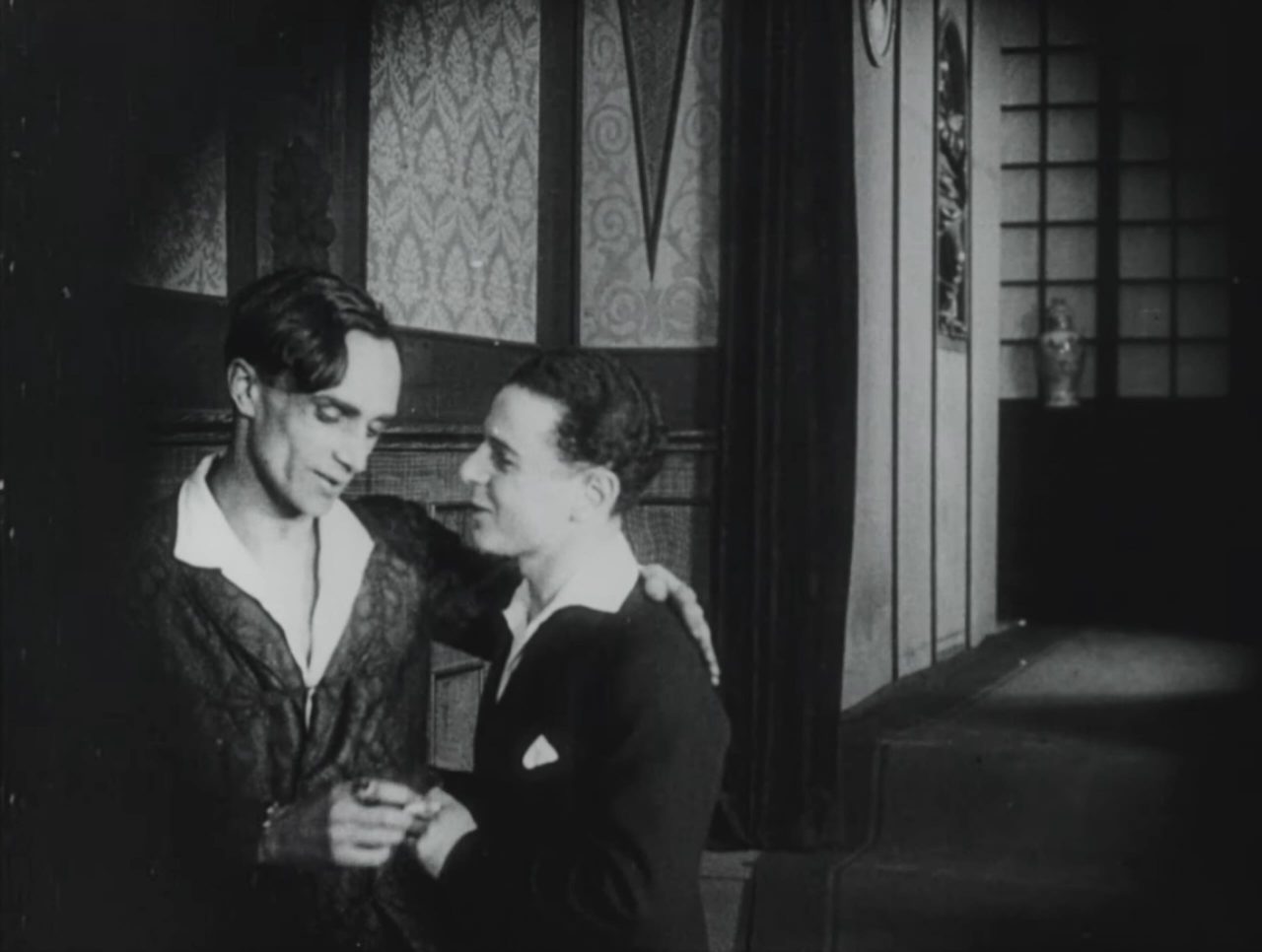
When historians and critics discuss Different from the Others, they tend to highlight its sympathetic portrayal of a gay romance—the film was meant in part to rally support for abolishing Paragraph 175 of the German Penal Code, which criminalized male homosexuality—and also tend to talk about how Different from the Others only exists in pieces today, a combined result of Nazi censorship and the natural decay of early film stock. The scenes that survive stitch together the story of a famous violinist and teacher, Paul Körner (Veidt), who falls in love with one of his male students, Kurt. A man called Bollek (Reinhold Schünzel) uses Körner’s homosexuality—illegal in Weimar Germany—as leverage, extorting money by threatening to report him to authorities. Eventually, Körner is exposed to the public eye and his career plummets. After reflecting on the enduring struggles of his life and finding nowhere to turn, he kills himself in his own home.
While Different from the Others rightfully earned recognition for its significant contributions to gay rights advocacy and silent film history, the film also masters something quite challenging: while early films worked through various ways to represent different emotions on screen, Others managed to capture the look and experience of loneliness.
Loneliness doesn’t register on a body, or in a voice, the same way as other emotions like love, fear, or anger do. It’s not always easy to detect, and sometimes mistaken for different, more visceral emotions. One may feel lonely, but not necessarily look it. As social historian Fay Bound Alberti points out in A Biography of Loneliness, “While the psychology of loneliness is well explored, reinforcing the idea that loneliness is a mental and individual rather than a social and physical experience, the embodied experience of loneliness has been neglected.”
Different from the Others addresses “the embodied experience of loneliness” head-on, but not in the way you might initially expect. There are many shots of Körner alone in his lavish apartment, the frequent iris framing creating a tunnel-like effect that doubles down on his physical state. Some of the shots of Veidt alone are also the ones where he has the most sex appeal: lanky and pensive, with a face that could certainly launch a thousand ships. It’s a potent cocktail whose brooding finds footing in literary figures ranging from Emily Brontë’s Heathcliff to the latest Bridgerton babe.
But can we assume Körner feels lonely just because he is by himself? When it comes to loneliness, things often register differently in silent movies than they do in literature or on television. Silent films often used intertitles, flashbacks, and cinematography to visualize emotions, and experiments with the close-up grew in the second decade of the 20th century. Early film scholar Béla Balázs saw the close-up as uniquely powerful in representing loneliness. Unlike theater, where a soliloquy demands an empty stage, a close-up can reveal a character’s isolation even while in a crowded room. For Balázs, the close-up clearly illuminated how humans experience loneliness.
Although I admire Balázs’s writing on the close-up, I’m not completely persuaded because his theory relies on the single instant or singular shot. This certainly works when representing episodic spurts of emotion—a declaration of love, an outburst of anger—and Veidt’s captivating performance often trades in these melodramatic conventions, his face simultaneously expressive and gaunt, elegant yet vulnerable. But relying on a close-up doesn’t always work for something like loneliness, which is rarely defined by a sharp rise and fall of expression; access to a character’s inner thoughts, whether by way of soliloquy or POV shots, isn’t a guaranteed shorthand for loneliness. A broader understanding of this emotion, as demonstrated by Different from the Others, regards the mise-en-scène as well, and how characters interact with the objects in it.
*
Silent films are uniquely situated to attend to objects within a frame. Absent synchronized sound and music, the images take on a voice of their own. Because loneliness is a deeply subjective emotion which doesn’t always have an obvious external corollary, Different from the Others uses material objects to animate the hostility in Körner’s world. For gay individuals, loneliness is often part and parcel of trying to stay alive, but seeking relief from that loneliness by pursuing a same-sex romantic partner can have dangerous strings attached. I won’t anachronistically import modern discourse back onto this film—such a move does a disservice to the discrimination queer people faced in the past that differed in many ways from current threats—but even now, in the 21st century, engaging in non-heterosexual relationships still invites serious professional and personal risks. This unfortunate reality is a death sentence for Körner.
Körner’s loneliness is conveyed throughout Different from the Others by various objects: a small sculpture, a photograph of his younger self, and cigarettes.
Cigarettes appear often in silent films, not simply because they were more prevalent in daily life, but also because the smoke itself looked sexy on black-and-white film. However, it’s not their practicality or aesthetics that speak to loneliness in this film, but rather how the cigarettes are circulated, shared, and discarded.
We first meet Körner smoking in his home, in a scene that takes place after Bollek the blackmailer caught Körner and Kurt acting affectionately in a public space. Bollek invades Körner’s private space to ask for “hush money.” Körner faces the camera, lying prostrate on his chaise lounge. He is smoking, as if deep in thought, possibly to soothe his nerves from the previous encounter. When he’s confronted by Bollek, Körner stands up but keeps the cigarette in hand, small whirls of smoke floating upward. Bollek sits down in the spot Körner has just vacated and, while Körner hovers in the background near the fireplace, Bollek takes advantage of his distractedness to steal what appears to be a small pocket mirror. After Körner pays Bollek the money, he begrudgingly offers a cigarette case, from which the blackmailer first takes a cigarette and then absconds the entire case before exiting the room. Körner can’t protest the theft and buries his head in his hands.
Symbolically, Bollek has taken away Körner’s ability to see his own reflection, as well as the comfort of always having cigarettes at the ready. The scene thus subverts the often social, even intimate, activity of sharing a cigarette with someone. Instead, the loss of the cigarettes and their case makes apparent how lonely and vulnerable Körner is in the company of those who wish him harm.
While the cigarettes draw attention to Körner’s emotional state, the film’s visual language also embeds meaning in less obvious objects, such as the small sculpture that Körner has in his room. The sculpture appears in the background in earlier scenes, difficult to distinguish among the opulence. As the story progresses, the camera moves into the background of the earlier shots, so the background of Körner’s room becomes the foreground. This staging not only makes the sculpture more visible, but also creates the illusion that Körner’s space has shrunk.
In the first scene between Körner and Bollek, the sculpture becomes somewhat discernible. It appears to be a man with his arms outstretched, in one hand brandishing what looks like a rapier sword, his entire body exposed, his chest open wide. A few scenes later, in Körner’s lengthy flashback, he’s in the same room as Bollek. The blackmailer walks over and rests his hands at the base of the sculpture. His palms linger on the sculpture for several moments, a gesture of familiarity. Körner has brought the man back to his home out of romantic interest, but is unaware that he means to trap him. The sculpture operates as a sort of frozen totem of the hope of intimacy that ends in betrayal.
After the flashback, the sculpture appears a few more times, its final and most prominent spot taking center stage when Körner chooses to end his life. After he’s exposed by Bollek and loses his artistic livelihood, Körner takes a pill to commit suicide. As he gradually weakens, he sits down in a chair positioned directly in front of the statue. The statue brings back his earliest encounter with Bollek—when an attempt to treat loneliness with male companionship further exacerbated his vulnerability, rendering him even more lonely as a gay man in a heteronormative world—and Körner crumples into a heap, the sculpture of a triumphant man looking over his shoulder, a harsh and devastating contrast. The only witness to Körner’s lonely death is an object that, staged in this way, appears to be standing victorious over his body.
While cigarettes and a sculpture allow Körner’s loneliness to register across different times and interactions, it’s Körner’s photograph of his younger self that solidifies how Different from the Others explores loneliness in its troubled protagonist. In a medium shot, he gazes longingly at his own portrait. For a film that relies frequently on close-ups for scenes of emotional anguish, the absence of a close-up on Körner’s face in this crucial scene invites other reflections beyond a fixation on Körner’s expressions. We take in his broader body language and the objects all around him, including the sculpture in the background and the photograph he cradles. We get a quick glimpse of the young version of Körner in the photograph as it falls from his trembling hands, his emotions strong enough to launch a flashback to when he was a promising student and up-and-coming violinist. Handsome and vivacious, this younger Körner tries to understand what, to quote the film’s title, makes him different from the others. During this flashback sequence, we are told twice (through intertitles) that Körner was lonely when he was younger, offering further evidence for the chronic nature of his experience.
One might expect the photograph to reinforce Körner’s loneliness simply because he appears alone in it, or because an intertitle explicitly labels him “lonely and desolate.” But the true source of this effect lies in Körner rejection of his own image. The photograph falls forward, so we can quickly glimpse the portrait before it exits the frame. Körner’s feeble attempt to assuage his loneliness by literally “facing” his former self only further signifies his despair, even eye contact—and thus connection—with his younger image becomes untenable; he has no choice but to look away. His loneliness has progressed beyond feeling disconnected from other people to something arguably worse: feeling disconnected from himself. And absent his pocket mirror, thanks to Bollek, his options for where to look to grasp at his own flesh-and-blood existence are dwindling fast. The external signs that he’s alive are disappearing. The disappointment is so unbearable that Körner quietly severs his gaze.
*
Veidt’s restraint in this moment is crucial to understanding Different from the Others’ lasting impact on cinema. By developing subtle material techniques to depict a chronic emotion like loneliness, the film moved beyond sentimentality. Instead of simply asking an audience to feel sorry for Körner, it invites us to understand the ragged texture of his day-to-day life. In that vein, Different from the Others is often categorized as either didacticism or melodrama, and it certainly contains elements of both (the film includes co-writer and sexologist Magnus Hirschfield’s lecture sequences which explicitly argue for homosexual rights, and Veidt certainly was a master of melodramatic expression) but Different from the Others‘ approach to loneliness sits somewhere in between these categories, neither strict instruction nor lavish hyperbole. It takes up the swirl of melodrama and the rigidity of a lecture without reducing Körner to a symbol of empathy or enlightenment.
That Different from the Others survives only in fragments seems rather fitting for a film about loneliness, that emotion of incompleteness, of something missing. And perhaps this emptiness would’ve resonated with Veidt himself, who eventually lived in exile from his native Germany. He fled with his Jewish wife to escape Nazi persecution and they settled in England, where they aided the war effort during the Blitz, before emigrating to the United States. In 1943, Veidt died of a heart attack at just 50 years old in Los Angeles, never seeing the final outcome of World War II. Whereas Different from the Others feels cut up, Veidt’s life feels cut short.
Yet, Different from the Others’ various splinters demonstrate how successful it was in developing a language for loneliness. Even in its incomplete state, it makes the invisible visible, tending lovingly to the missing pieces. Others also revealed to me how my own loneliness took shape over the course of my life, shifting troubled feelings from my peripheral vision to center stage. That evening with my mother watching Casablanca was about the shared space that connected us. In the anonymity of New York City, I learned that loneliness wasn’t the absence of people, but rather the absence of meaningful interactions, the kind Körner lost his life trying to pursue. Time and time again, Conrad Veidt brought me back to my mom, and our love of watching old movies together, reminding me along the way that cinema can be an enduring source of companionship, too.